



Redazione RHC : 3 December 2025 15:52
70 million simultaneous 8K videos at 570 Tbps ! This is a staggering amount of transport power in a submarine cable and will change internet access in the Asia-Pacific region.
Candle is more than just a submarine cable: it is the backbone of the Asia-Pacific digital economy . With its massive capacity of 570 Tbps , the extreme density of 24 fiber pairs, and the resilient ring route design , it has completely rewritten the rules of site selection, topology, energy, and data center business models.
As Tomonori Uematsu, General Manager of NEC Submarine Networks, said, “Candle connects Asia’s isolated cyber islands into a continent.” When the first beam of light illuminates the Qiancang CLS in 2028, the Asia-Pacific data center ecosystem will usher in a true “light flood” era.
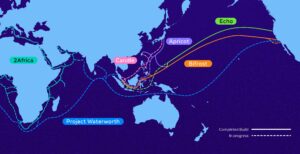
In October 2025, Meta , along with SoftBank , NEC, PLDT, TM, and XLSmart, officially announced the launch of the Candle submarine cable system . This line extends 8,000 km from Chikura, Japan in the east to Tuas , Singapore in the west, connecting Tamsui, Taiwan; Balal, Philippines; Batam, Indonesia; and Kuantan, Malaysia.
Compared to existing Asia-Pacific submarine cables, Candle’s capacity is 2.7 times that of Apricot (211 Tbps) , which entered into operation in 2021, and more than 10 times that of APG (54 Tbps) in 2016. The name ” Candle ” means “illuminating the entire Asia-Pacific digital night sky with candlelight” and also metaphorically represents its role as the ” leading torch” for regional computing power and energy synergy.
Traditional 8-12 pair cables are reaching their limits due to their outer diameter and installation costs. Candle is the first company in the Asia-Pacific region to adopt 24-pair cables on a large scale, reducing the cost per bit-kilometer by 35% thanks to a smaller diameter 200 µm fiber and a shared reinforcement core.
With a 1550 nm window attenuation of ≤ 0.150 dB/km, combined with Raman amplification, the distance without electrical repeaters can be extended to 450 km, reducing the number of repeaters by 30%. NEC’s pluggable ROADM repeaters support the addition and subtraction of remote wavelengths and can be dynamically expanded as the business grows, without the need for additional submarine cables.
The Candle cable lands on the eastern coast of Luzon Island in the Philippines , then crosses the Sulawesi Sea, the Java Sea, and the outer edge of the Strait of Malacca, avoiding the disputed waters of the South China Sea. On the Malaysian segment, it uses the Kuantan CLS and the Singapore Tuas CLS to form a double landing point, ensuring that, in the event of an anchor failure in the Strait of Malacca, flow can be diverted to a backup landline within 50 ms . Furthermore, the Senkura CLS in Japan and the Tamsui CLS in Taiwan are only 2,100 km apart, reducing the Tokyo-Taipei RTT from 35 ms to 28 ms, providing a “microsecond” advantage for high-frequency trading and real-time AI inference.
570 Tbps is equivalent to 70 million simultaneous 8K videos, or the interconnection of 120 100 Tbps supercomputing centers. For hyperscalers, this means that training clusters originally distributed across Singapore, Tokyo, and Jakarta can be ” flattened ” into a single logical cluster, reducing gradient synchronization latency by 40% and shortening the training cycle of large models by 15-20%.
The traditional “starburst” architecture, centered on Singapore, forces traffic from Indonesia and the Philippines to travel first “north” and then “south.” Candle’s ring design allows Jakarta and Manila to be directly interconnected via a 3,800-km submarine cable, reducing latency from 65 ms to 28 ms and enabling the deployment of edge inference nodes in second-tier cities like Medan and Cebu.
Indonesia’s 2.2 GWp + 12 GWh floating solar PV energy storage project plans to transmit electricity to Singapore via a 400 kV undersea cable. Candle’s CLS is located adjacent to the power landing station, allowing the data center to consume nearby green electricity , potentially reducing its PUE from 1.35 to 1.15 and thus achieving “green electricity-derived computing power.”
 Redazione