



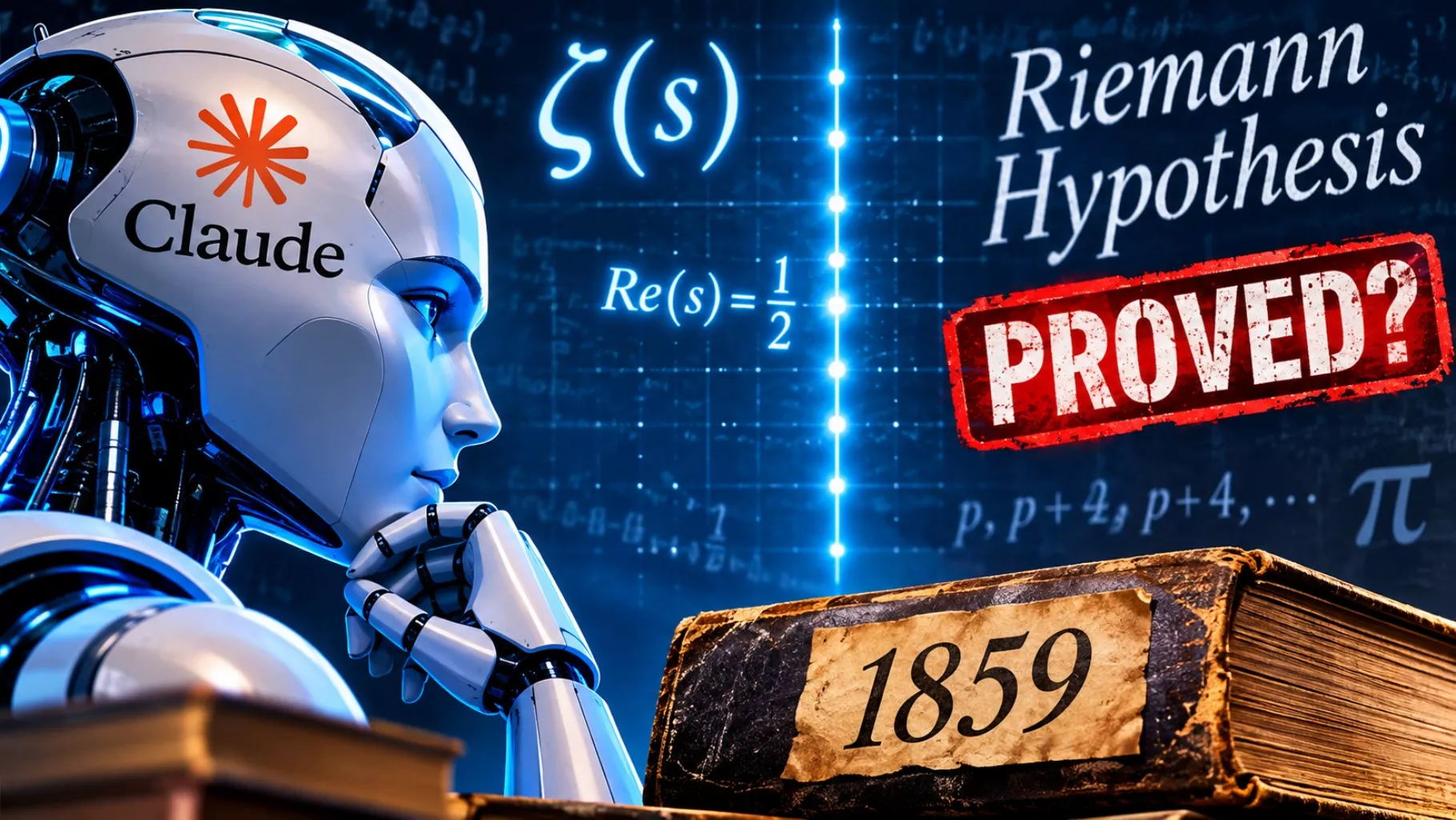
The mathematician Levent Alpoğe of Anthropic said he has found, thanks to the neural network Claude, a proof of the Riemann hypothesis, which mathematicians have been working on since 1859. The news generated huge interest: the formal proof passed independent checks, but for some researchers the long‑awaited victory turned into an unexpected feeling of loss. In fact, the puzzle they have devoted years of their lives to finally received an answer, yet understanding how the solution was possible remains extremely complex.
The author of the scientific work dedicated to this story experienced the news in a particularly intense way. He has a tattoo on his leg depicting the zeta function ζ(s), on which the Riemann hypothesis is based. During his university years, the author devoted about a year and a half to studying the problem, then decided to keep the mathematical symbol on his skin. It seems that the emergence of a proof should have been a cause for celebration. Instead of enthusiasm, the author felt a sense of emptiness.

The Riemann hypothesis concerns the distribution of prime numbers, which are divisible without remainder only by one and themselves. Mathematicians have long known how to roughly estimate the quantity of primes in large intervals, but the accuracy of such estimates depends on regularities that have so far been described only partially. Riemann hypothesized that all non‑trivial zeros of his zeta function lie on a single vertical line in the complex plane, where the real part of each solution equals 1/2. Confirming the hypothesis would allow a more precise description of the distribution of prime numbers.
On November 20, Alpoğe published a statement on the result obtained and attached an archive containing roughly 17.4 million lines of Lean code. Instead of a traditional scientific article, the mathematician presented a formal recording of the proof, which special programs can verify step by step. Alpoğe worked with Claude for several months, guiding the research and proposing mathematical ideas, but toward the end the neural network began finding solutions faster than the researcher could comprehend them.
On November 21, the Lean developer community and the Mathlib mathematical library confirmed the correctness of the formal proof. Independent verification programs accepted the published code, and experts determined that the formalized statement indeed corresponds to the Riemann hypothesis. Thus, computer verification confirmed the logical validity of the solution. However, reconstructing the chain of mathematical reasoning and explaining the method in terms understandable to researchers remains a task to be tackled.
This is precisely where the main reason for the mixed emotions lies. For mathematicians, the value of the hypothesis did not reside simply in the possibility of declaring it proven one day. Researchers hoped that the solution would open new ways of thinking about numbers, uncover unexpected connections between areas of mathematics, and provide tools for future discoveries. Ultimately, the journey toward the answer mattered, not just the answer itself.
At present, the main ideas remain inside a massive block of machine code. Alpoğe intends to delve into the mathematical constructions that the neural network helped uncover and prepare an understandable exposition. The same researcher acknowledged that he presented the proof before fully assimilating all the underlying mathematics. Even a successful computer verification does not eliminate the need to explain to other scientists why the reasoning leads precisely to the desired result.
The story has prompted researchers to rethink the role of artificial intelligence in mathematics. In the past, the main concerns centered on the type of work neural networks would take away from humans and how the mathematician’s profession would change. Now a fundamental question has emerged: what will happen to the very essence of scientific discovery if a machine can find solutions faster than a human can grasp their meaning?
The author does not hide his admiration for AI’s capabilities and at the same time admits feeling a strange sense of emptiness after the news. The hypothesis that has inspired mathematicians for decades has received a formal proof, but its main intellectual puzzle has not yet vanished. Now scientists will have to uncover what ideas lie behind the millions of lines of code and what new discoveries will emerge thanks to the found solution.