



After Microsoft, it’s Apple’s turn! On November 17, 2026, thousands of users reported issues with Apple Support, the App Store, iCloud and Apple Pay. In the initial phase, the situation shown by Downdetector did not match Apple’s status page, as the latter indicated that almost everything was functioning normally.
Only later did the status page align with it. At 21:05 Italian time, i.e., more than three hours after the first reports, the page still showed outages, with multiple services affected.
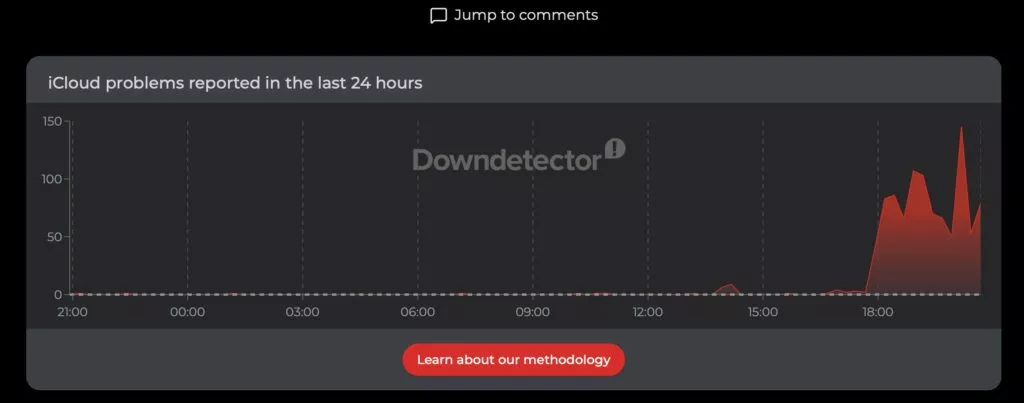

Reports concerning Apple Pay began to rise around 11:40 a.m. Eastern US time, i.e., 17:40 Italian time. Reports on iCloud followed shortly after, appearing just before noon Eastern time. In less than an hour, the problem had already spread to Apple Music, Apple account sign‑in, iPhone activation, as well as the developer portal App Store Connect.
The most annoying symptom was forced disconnection. Many users reported being unexpectedly logged out of iCloud and, when trying to sign in again, verification errors or generic messages appeared; biometric authentication also failed and accessing the iCloud page was unsuccessful. The App Store could not load or download apps. According to 9to5Mac, Apple stores and offices might also have been affected, but this has not yet received official confirmation.
The developer page revealed more information. In the later stages of the incident, that page listed Apple Business, Apple School Manager, Schoolwork, iCloud Mail, the iCloud web apps, Xcode Cloud and App Store Connect, in addition to consumer services.
From a CTI (Cyber Threat Intelligence) perspective, this is not a problem of a single service but a failure in one of the layers that connect the various services: authentication and accounts. Analyst James Knight, cited by Tom’s Guide, emphasized that the issue lay in sign‑in and accounts, with the Apple ID as the common failure point. This analyst also warned not to click on emails or SMS messages concerning “verification” of the Apple ID during the incident. Gadget Review, on the other hand, advised not to log out of iCloud during the authentication instability period, as it might later be impossible to sign in again.
Apple has not explained the cause, nor issued statements, and it has not even responded to Tom’s Guide’s request for comment. However, it has updated the status page, which deserves to be read in full.
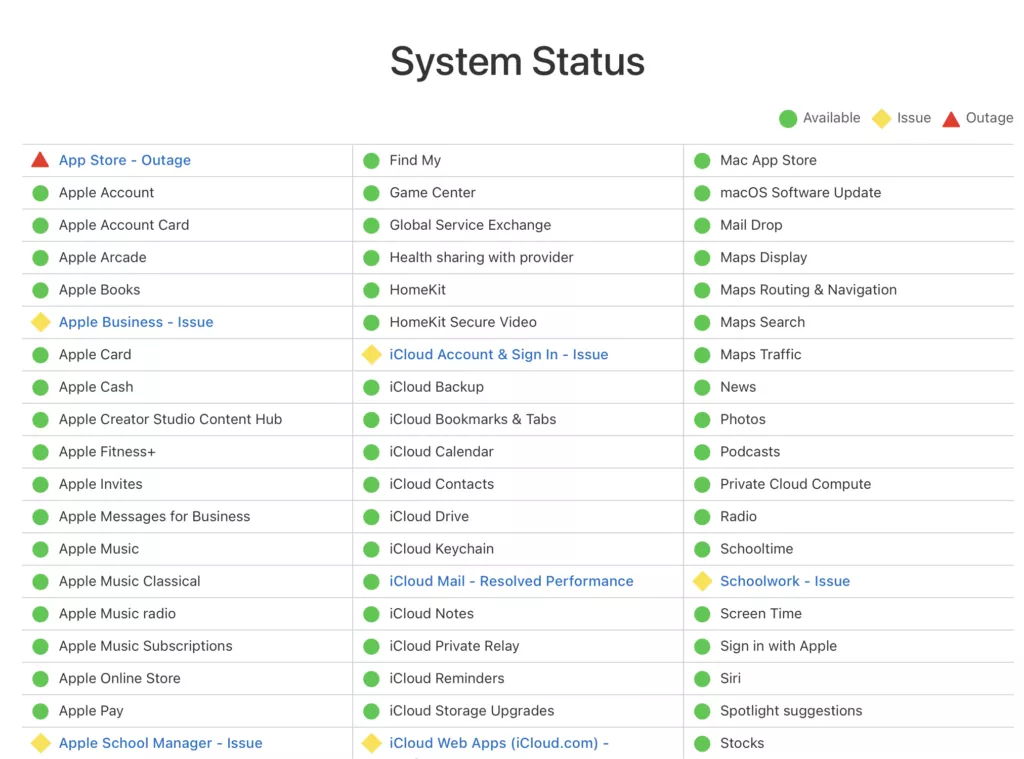
At 21:05 Italian time, the App Store was in a state of outage. iCloud account and sign‑in, Apple Business, Apple School Manager and Schoolwork were showing a issue, while the iCloud web apps were experiencing reduced performance. iCloud Mail was resolved.
Conversely, Apple Pay, Apple Card, Apple Cash, Apple Music, Apple Account, Sign in with Apple, iOS device activation and subscription purchases had become available again.
In other words: the consumer side is recovering, while the enterprise side is not. Access to iCloud and tools for businesses and schools remains lagging. The various updates throughout the day reflect this fragmented restoration process: The Detroit News reported that at 14:02 Eastern time the App Store and Apple Music had been restored, while Tom’s Guide noted at that moment that other services were still unavailable. What we are seeing now is the result of a partial recovery, not the end of the incident.
This does not rule out a malicious origin, but at present there is no evidence supporting that hypothesis. The Apple Post has clearly stated that there is no evidence linking this episode to a security incident. The status page also does not explain the cause.
Contextual information helps avoid hasty conclusions. On November 10, Apple had confirmed another iCloud outage that affected Mail, Contacts, Calendar and the “Find My” feature, and the same source warned against assuming a common cause. Moreover, the day before, technical problems had also hit the online banking of several major U.S. banks. A series of events does not equal correlation. At present, they are merely independent incidents that happened on the same calendar.
At the time of writing this article I can confirm that the problems also affect Italian users. Apple devices are reporting iCloud account sign‑in issues.
These kinds of failures, in themselves, do not require attackers to create risks. It is enough for the entire user base to become accustomed to clicking “Sign in again” under pressure. We anticipate that, in the coming hours and days, SMS and email messages with the subject “Your Apple ID has been suspended” will appear, exploiting the memory of this service outage. This is a CTI forecast, not a confirmed fact.