




The Chinese artificial intelligence lab Moonshot AI unveiled Kimi K3.1 Pro — an updated version of the Kimi K3 model, which underwent further training using a larger volume of compute resources. In the Artificial Analysis Intelligence Index ranking it scored 55 points, surpassing its predecessor by 11 points, beating all OpenAI models and taking fourth place.
Above Kimi K3.1 Pro in the ranking are Anthropic Claude Opus 5.5 (58 points), Claude Sonnet 5.5 (56 points) and Meta Muse Wonder Full (56 points). Moonshot AI plans to open‑source the model weights on November 4, and it will become the most powerful in the open‑system class. The gap between open and proprietary models will shrink from 12 to 3 points, unless the market situation changes by then. The developer also released the Kimi K3.1 Pro Highspeed version — it runs two to three times faster. Both models are already available on the Kimi.ai, Kimi Work, Kimi Code platforms and via API.
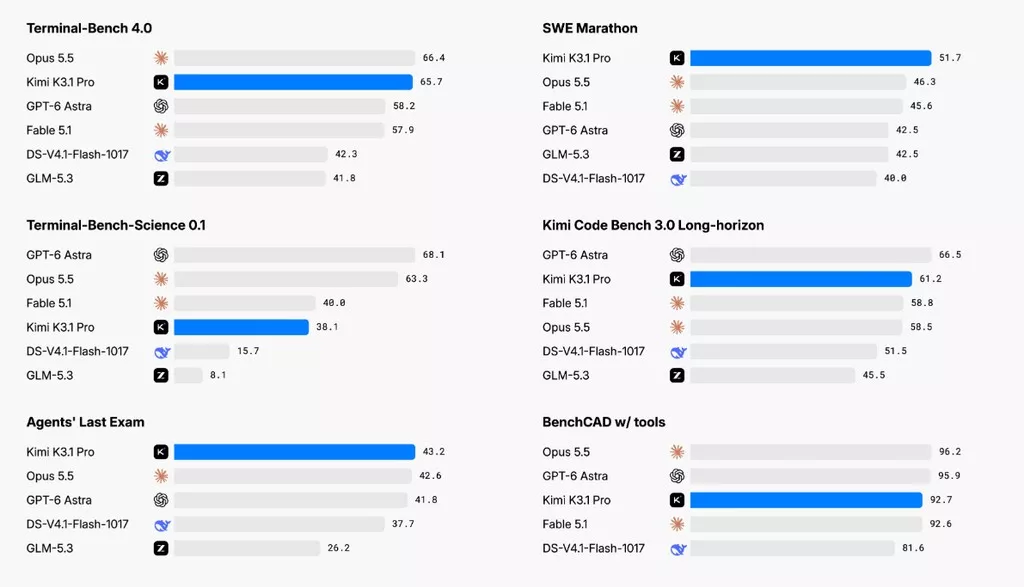

The most noticeable improvement of Kimi K3.1 Pro appeared in agent‑based tasks: in the GDPval‑AA benchmark it scored 1846 Elo points, surpassing K3 by 312 points. Here it was beaten only by Claude Opus 5.5 (1866 points) and Wonder Full (1857 points). In Terminal‑Bench 4.0 it achieved 65.7%, outpacing OpenAI GPT‑6 Astra (58.2%) and falling just short of Claude Opus 5.5 (66.4%) — K3 scored only 13% in the same test.
In an internal test, Kimi Hallu Bench Hard, the hallucination rate—responses clearly not matching reality—dropped from 23.4% for K3 to 8.3% for the new model. Moonshot emphasized this is a stress test, not a general error‑rate indicator; for comparison, GPT‑6 Astra recorded 5.5% in the same test, thus retaining the lead. In financial tests Kimi K3.1 Pro showed a gain of 7.2 points in financial modeling direction and 11.6 points in financial research. In the OfficeQA Pro v2 benchmark related to office tasks, the model outperformed all competitors, Moonshot says.
Kimi K3.1 Pro supports direct interaction with game engines, including Unity, Unreal Engine and Godot — it can make operational corrections and produce project builds. Using auxiliary tools in the BenchCAD test it achieved 92.7%, approaching the results of Claude Opus 5.5 (96.2%) and GPT‑6 Astra (95.9%). Without tool usage the score fell to 72.8%, almost identical to Claude Opus 5.5 (73.0%). The model performs best in parametric modeling of mechanical parts, architectural objects and items with configurable parameters. It can create and run scripts for Blender and CAD systems without an MCP‑connector. On the Kimi.com platform the 3D Make feature has appeared — it allows viewing, editing and exporting three‑dimensional models.
The Kimi K3.1 Pro model inherited the size of its predecessor — 2.8 trillion parameters, of which 104 billion are active. Its context window is 1 million tokens, supporting work with text and images. According to Artificial Analysis data, it sits at the top of the “Pareto frontier“; it has the highest Intelligence Index score among similarly sized models.
The operating cost dropped by 33%: $2 per 1 million input tokens (was $3), $10 per 1 million output tokens (was $15) and $0.20 for cached data operations (was $0.30). Running a task from the Intelligence Index set costs $1.98 — almost the same as K3 ($2.00) — while the new model generates 14% more output tokens.
With the gradual improvement of the post‑training phase, the model’s vulnerability‑search capabilities have strengthened, Moonshot noted: cybersecurity materials were present in the general dataset, and the corresponding tasks were included in the reinforcement‑learning environment. In preparing the open‑weight version, the developer removed cybersecurity data in both training phases. In internal tests with the xdev‑bench‑hard benchmark, which includes recently discovered vulnerabilities in the Linux kernel, Node.js and JavaScriptCore, the original model version successfully completed 90.5% of tasks; after data removal this figure dropped to 81.0%. For comparison, in the same test DeepSeek‑V4.1‑Flash achieved 85.7%, while Kimi K3 achieved 33.3%.
Open‑weight models should not expand the boundaries of possibilities in offensive cybersecurity, Moonshot believes. At the same time, the lab aims to gradually improve the capabilities of open models, perché they could also prove useful in defense — for example, in analyzing legacy systems. Previously, Anthropic showed that the Chinese model Z.ai GLM-5.3 with 45 points in the AA Index can create exploits, at a complexity level comparable to those generated by Claude Mythos.