
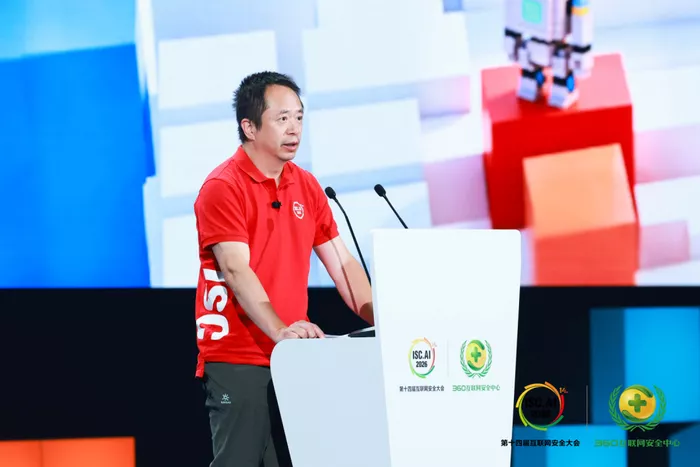
Qihoo 360 has presented an artificial intelligence-based vulnerability scanning system, which the company considers China’s response to Anthropic’s Mythos. Qihoo 360’s CEO, Zhou Hongyi, presented the novelty at the 14th Beijing Cybersecurity Conference, stating that directly copying the American model (referring to Anthropic’s recent accusations) will not produce the desired results: China does not need a single “superpower” AI, but a team of specialized agents.
The company’s administrator defined Mythos as a “cyber nuclear weapon“, attributing this evaluation not to the model’s capabilities but to access restrictions.

The United States prevents foreign citizens from using the model, thus obtaining an advantage in identifying vulnerabilities in software on which other countries depend.
According to Zhou, the American approach is based on maximum performance: the most powerful model, the greatest computing resources, and the most advanced chips. Chinese models, according to Qihoo 360’s head, are currently about 20-30% inferior in basic functionality, so trying to replicate Mythos would directly lead to a gap, not parity.
Qihoo 360 offers a different approach. The company has leveraged 20 years of experience in investigating cyber attacks, data from a large malware database, and its own expertise in infrastructure protection to assemble specialized models and artificial intelligence agents. The system, named Tulongfeng, operates like a “swarm”, with multiple agents sharing analysis phases.
The system first models the threat and selects the most risky attack surfaces, then monitors data flows between files and searches for potential vulnerabilities. After the initial analysis, the agents automatically create sandbox, generate exploit code, and test it in conditions similar to those of a real attack.
Zhou compared Anthropic’s approach to training a single “genius hacker”, while Qihoo 360’s approach resembles the organization of a professional attack and defense team. After completing an activity, Tulongfeng analyzes its work and uses the results for subsequent checks, a process that, according to the company’s administrator, is difficult to replicate with a single large model.
Qihoo 360 claims that Tulongfeng is already identifying vulnerabilities in open-source and commercial software. Nearly 1,000 bugs in popular software have been mentioned. Zhou described a privilege escalation bug in the Windows kernel that went unnoticed for five years, a remote code execution vulnerability in Office that remained hidden for eight years, and a problem in Excel that went unnoticed for ten years. According to Qihoo 360’s head, Microsoft has officially recognized the discoveries.
The company is also promoting Yitianzhen, a tool for automatic evaluation of the cybersecurity level of organizations. The system simulates potential attacks, suggests solutions, and can implement protection measures. Qihoo 360 has gathered a coalition of Chinese companies around the project, which aims to strengthen the local market in a context similar to Project Glasswing, the program created by Antropic around Mythos.
Qihoo 360’s statements are also influenced by the political context. The company is subject to US sanctions for suspected provision of technology to the Chinese military. The Chinese National Virus Emergency Response Center regularly cites Qihoo 360’s research, and vulnerability research is becoming an increasingly significant part of the technological rivalry between the US and China.