



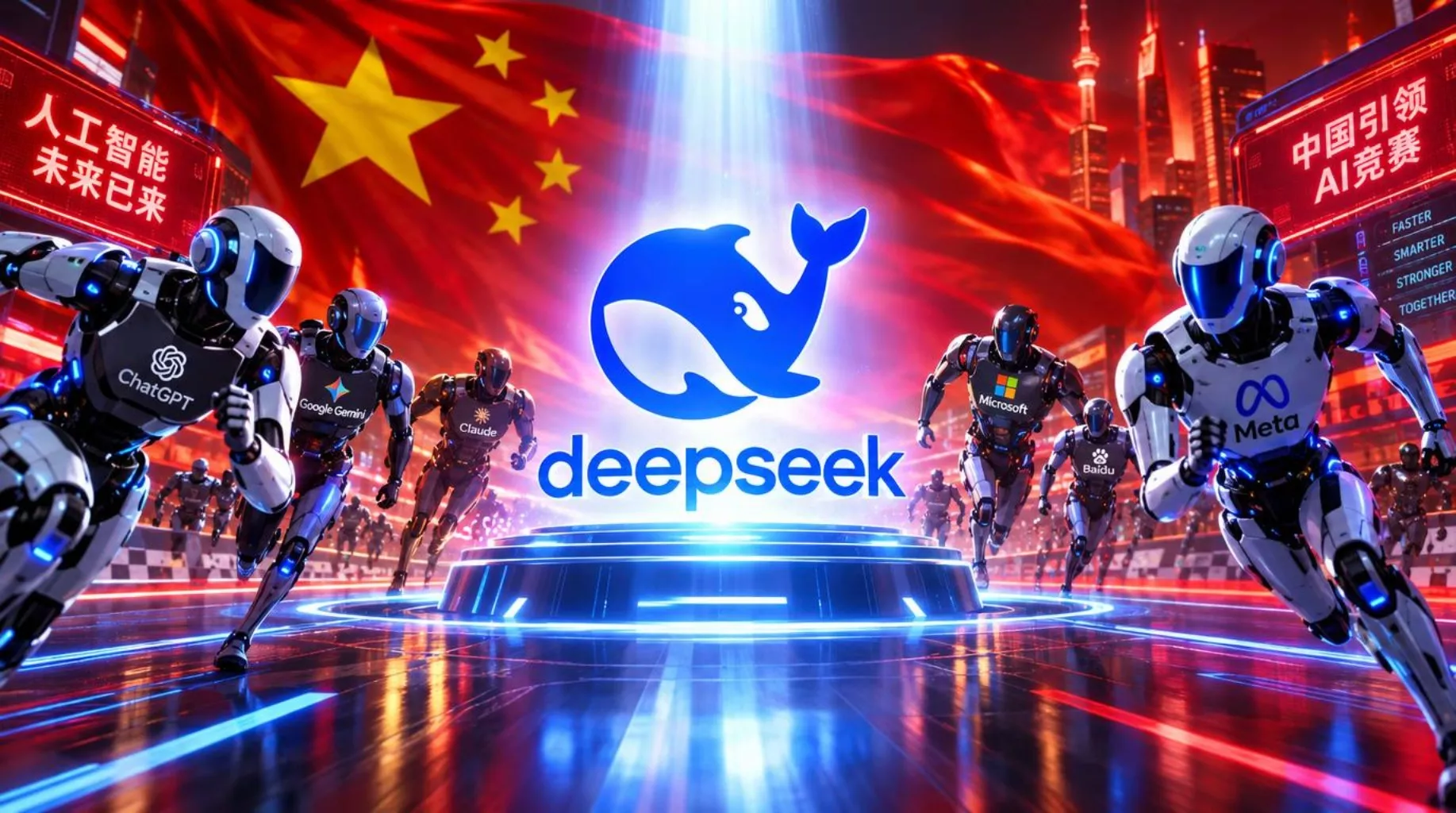
The real race in artificial intelligence no longer concerns only who can develop the most powerful model, but especially who will be able to dictate how this technology is used and distributed.
On one side there are the United States, with an ecosystem that also focuses on controlling cloud platforms, prompts, and inference, keeping models within centralized, paid infrastructures.

On the other side there are players like DeepSeek, which by openly releasing the weights of their models (open weight) allow companies to integrate them directly into their own datacenters, maintaining greater control over data and reducing dependence on costly cloud services.
Privacy versus centralization, open models versus subscriptions and inference costs: it is also on this ground that the next battle in artificial intelligence will be fought.
But back to the headline. The Chinese artificial intelligence company DeepSeek has raised about 100 billion yuan ($15 billion) in its latest financing round, becoming one of the largest in the country. Such massive investments indicate the startup’s intention to compete in the global market with Western developers such as OpenAI and Anthropic.
According to an informed source, DeepSeek doubled its financing target during negotiations with investors. Initially the amount was discussed to increase from 50 to 80 billion yuan, eventually reaching a final sum of 100 billion yuan. The main investors in this round were battery manufacturer Contemporary Amperex Technology and Tencent Holdings.
In 2025, DeepSeek caused a global market crash of $1 trillion, demonstrating the ability to compete with AI industry leaders at significantly lower neural network development costs.
At the same time, the company has never had a financial resource pool comparable to that of the most advanced American developers. The current financing round shows that this imbalance is gradually decreasing, although DeepSeek still has substantially fewer financial capabilities than OpenAI or Anthropic, each of which has raised over 100 billion.
According to the source, DeepSeek is preparing for an IPO, which will be an important step for the company.
Lately, DeepSeek has been allocating more resources to building AI data processing centers and developing a larger number of open-source models. The company regularly releases high‑performance and relatively inexpensive models, which increases pressure on local competitors and helps attract customers in the United States and other foreign markets.
In this scenario, the billions raised by DeepSeek (still far below those of the U.S. counterparts) demonstrate that the game is far from over and that the competition will be not only technological but also economic, strategic, and geopolitical.
The real question is which distribution model will prevail: artificial intelligence accessible through platforms controlled by a few large operators, or models that each company can run and govern autonomously.
And while the American and Chinese giants vie for this market, for NVIDIA the issue is, in the end, secondary: whether proprietary cloud or open‑weight AI installed in corporate datacenters wins, both require compute power. Competition between models can shift industry balances, but as long as artificial intelligence needs accelerators, hardware demand will remain at the heart of the game. Always.