



Gemini 4 Carbon, the brand‑new flagship model from Google DeepMind, was launched on October 28, 2026 and will be usable only by a limited group of cybersecurity experts.
Subsequently, Google plans to gradually open it to a larger number of organizations selected through the Fairwind program, which includes over 650 partners worldwide, as stated on DeepMind’s page.

We present Gemini 4 Carbon, our latest cutting‑edge model. Carbon delivers improved performance across all domains, ranking first in version 5.0 of the Intelligence Index by @ArtificialAnlys and setting a new standard of excellence in cybersecurity and long‑term capabilities. The launch is slated to begin this week for cybersecurity professionals via our Fairwind program, with broader access coming soon. – Google (@Google) October 28, 2026
Advertising
The price matches the rate of Gemini 4 Argon, the model launched two weeks earlier and that first reached Fairwind supporters. Koray Kavukcuoglu, senior vice president of Google DeepMind and head of Google’s AI architecture, described the release as a deliberate choice in the official announcement. His company is participating in a voluntary pre‑release testing process managed by the U.S. government.
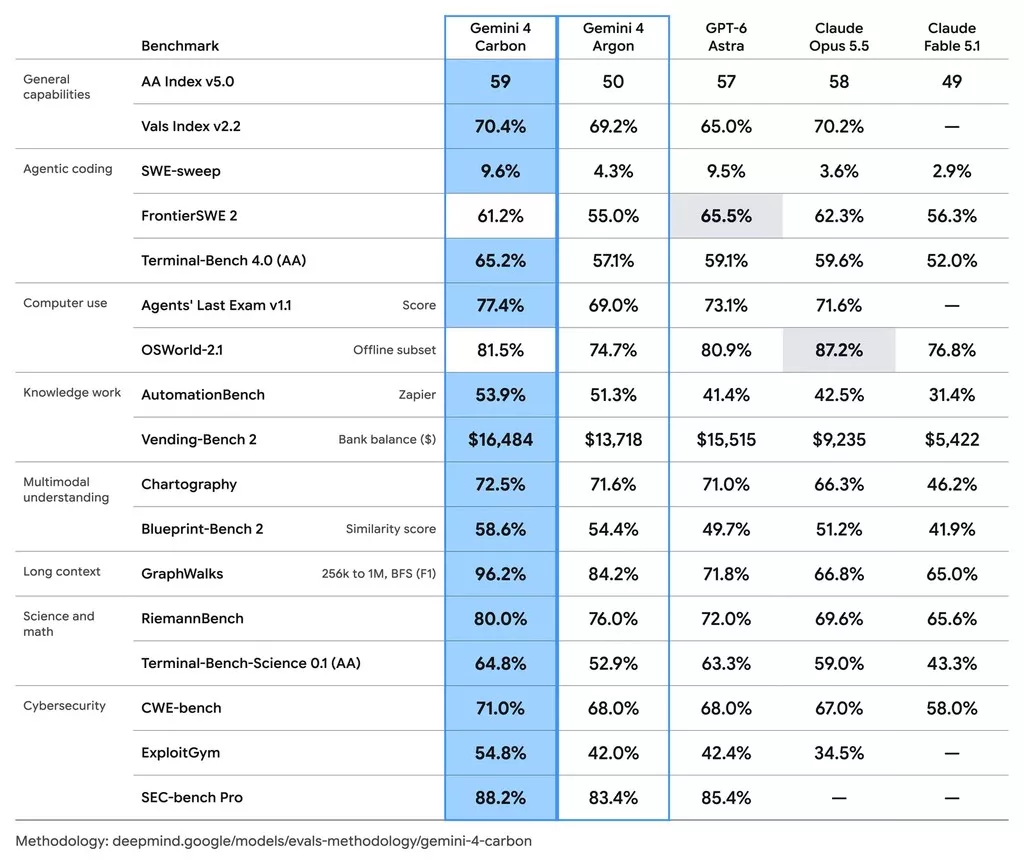
In the Artificial Analysis Intelligence Index, recently updated to version 5.0, Carbon achieved a score of 59 with the highest reasoning setting. Claude Opus 5.5 follows with 58, GPT‑6 Astra with 57 and Argon with 50. This lead puts Google one point ahead of Anthropic and two points ahead of OpenAI.
Input costs $2 and output $10 per million tokens, and everyone else, from app developers to enterprises and consumers, will be able to access the model through Google products once the company has gathered feedback and refined its guidelines. No release date has been announced yet.
Cached input, i.e., repeated request text already processed by the model, enjoys a 95% discount, roughly $0.10 per million tokens. After the launch period, rates will rise to $4 for input and $20 for output per million tokens, although Google has not disclosed an expiration date for the reduced pricing.
Kavukcuoglu linked the rapid release cadence to how Google now develops its systems. “Our researchers and our models work side by side,” he wrote. Security measures, he says, are strengthened in tandem with new capabilities.
Coding results on the Coding Agent Index, a separate evaluator’s index, placed Carbon in second place with 59 points when run in Antigravity CLI, three points shy of the 62 achieved by Claude Code combined with Opus 5.5. “Google has historically underperformed expectations in this area,” Artificial Analysis wrote on X.
Security is at the core of Google’s strategy. The results include an 88.2% score on SEC‑bench Pro, a vulnerability detection test, as well as 54.8% on ExploitGym for vulnerability exploitation and 71.0% on CWE‑bench for fixing root causes, all performed without restrictions.
Internal tests conducted by Google have shown that Carbon more than doubled Argon’s success rate in generating secure code. Reports of unsupported errors were halved compared to Argon and warnings about high‑severity misalignments dropped by almost 80% during real‑time coding sessions with Google teams.
every score reported in the announcement comes from Google’s internal tests. External developers still cannot run the model and independently verify these results.
Wiz, the cloud security firm now owned by Google, states that Carbon ranks first in its web penetration tests, as announced. Carbon also secured fourth place on WebDev Arena, after an 89‑point jump in its Elo rating that lifted it to 1768.