
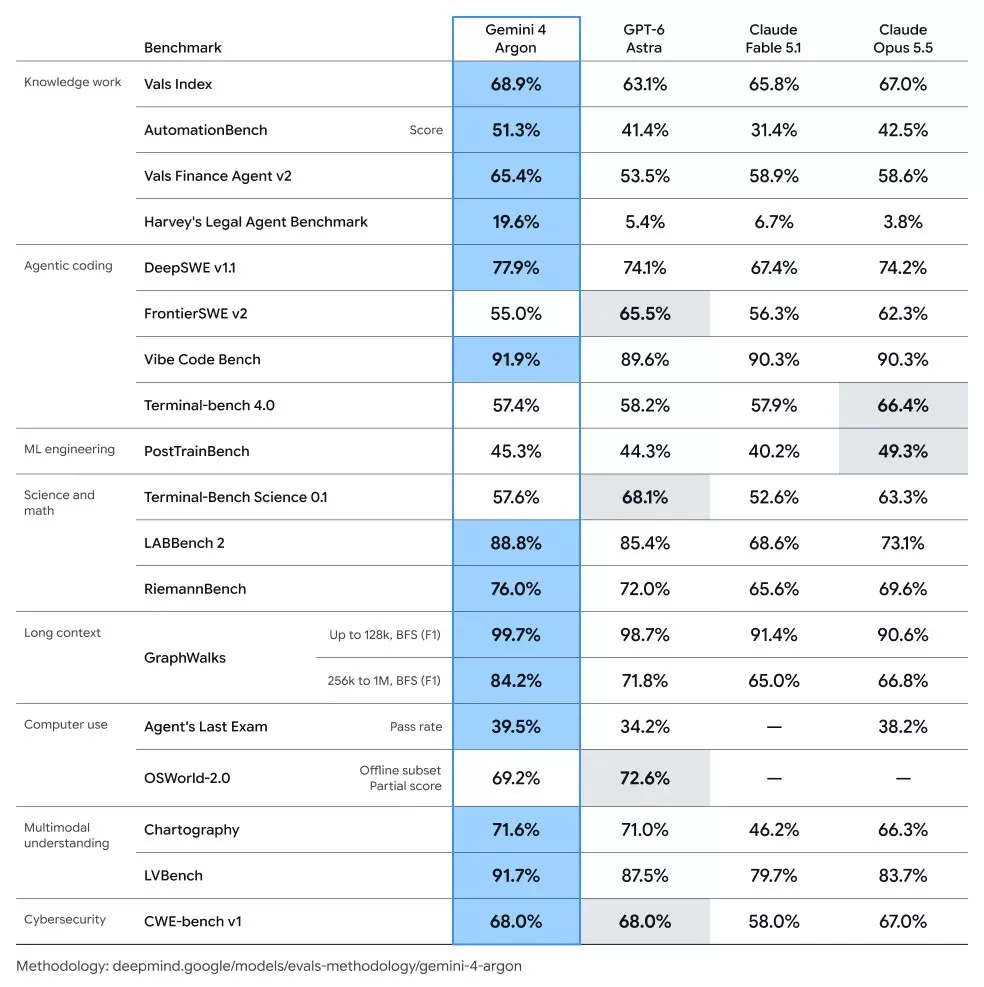
Google has launched Gemini 4 Argon, which will be rolled out to a group of cybersecurity experts through our Fairwind program. The model is designed to support deep reasoning in complex, long‑term workflows, Argon is radically changing the way we work and develop at Google. It delivers top‑tier performance in complex workflows across software engineering, knowledge‑based business tasks such as legal and financial work, and cyber defense.
The safe release of cutting‑edge capabilities at this scale requires a gradual approach. For this reason Google has activated a process that allows the U.S. government pre‑release access to frontier models, progressively expanding access.

Argon will be launched at a price of $0.5 per million input tokens and $10 per million output tokens, with cached input tokens priced at a 95% discount off the regular input token price.
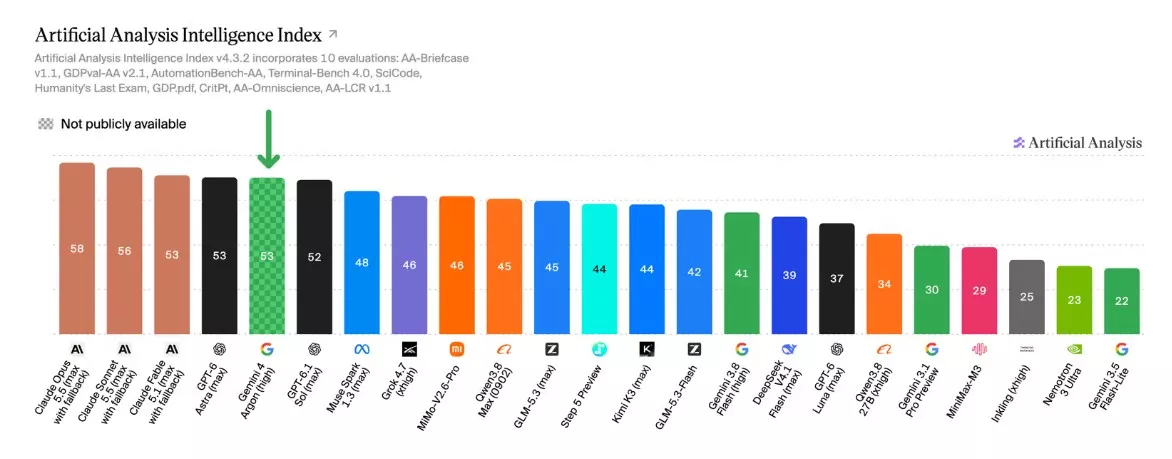
According to Artificial Analysis, an independent firm specializing in AI benchmarking, Gemini 4 Argon matches the score of GPT‑6 Astra on its Intelligence Index (the composite score derived from multiple AI benchmarks) at 60% of the cost per task, at current discounted prices. Astra costs $10 per million input tokens and $50 per million output tokens. Argon also scored one point higher than OpenAI’s GPT‑6.1 Sol. Its hallucination rate is 15%, the lowest among leading models, Artificial Analysis reported. GPT‑6 Astra has a hallucination rate of 54%, while GPT‑6.1 Sol also has a rate of 54%.
Gemini 4 Argon is already powering our internal workflows, with thousands of Google employees highlighting its strengths in specialized programming tasks, conducting deeper research, and writing quality. It is helping teams develop faster, push the boundaries of engineering productivity, and accelerate discoveries.
The highlights of the new model include:
To support Gemini 4 Argon’s capabilities in longer and more complex use cases, Google has significantly increased the model’s output token limit, raising it to 1 million tokens—a industry‑leading figure compared to the previous 64,000. When the model can process deeply and generate hundreds of thousands of tokens in a single request, it adds a new level of reasoning depth, enabling complex problems to be solved in one go.
Gemini 4 Argon succeeds Gemini 3.5. Google had planned to release a Gemini 3.5 Pro model earlier this year, but clearly chose to focus on developing Gemini 4.