


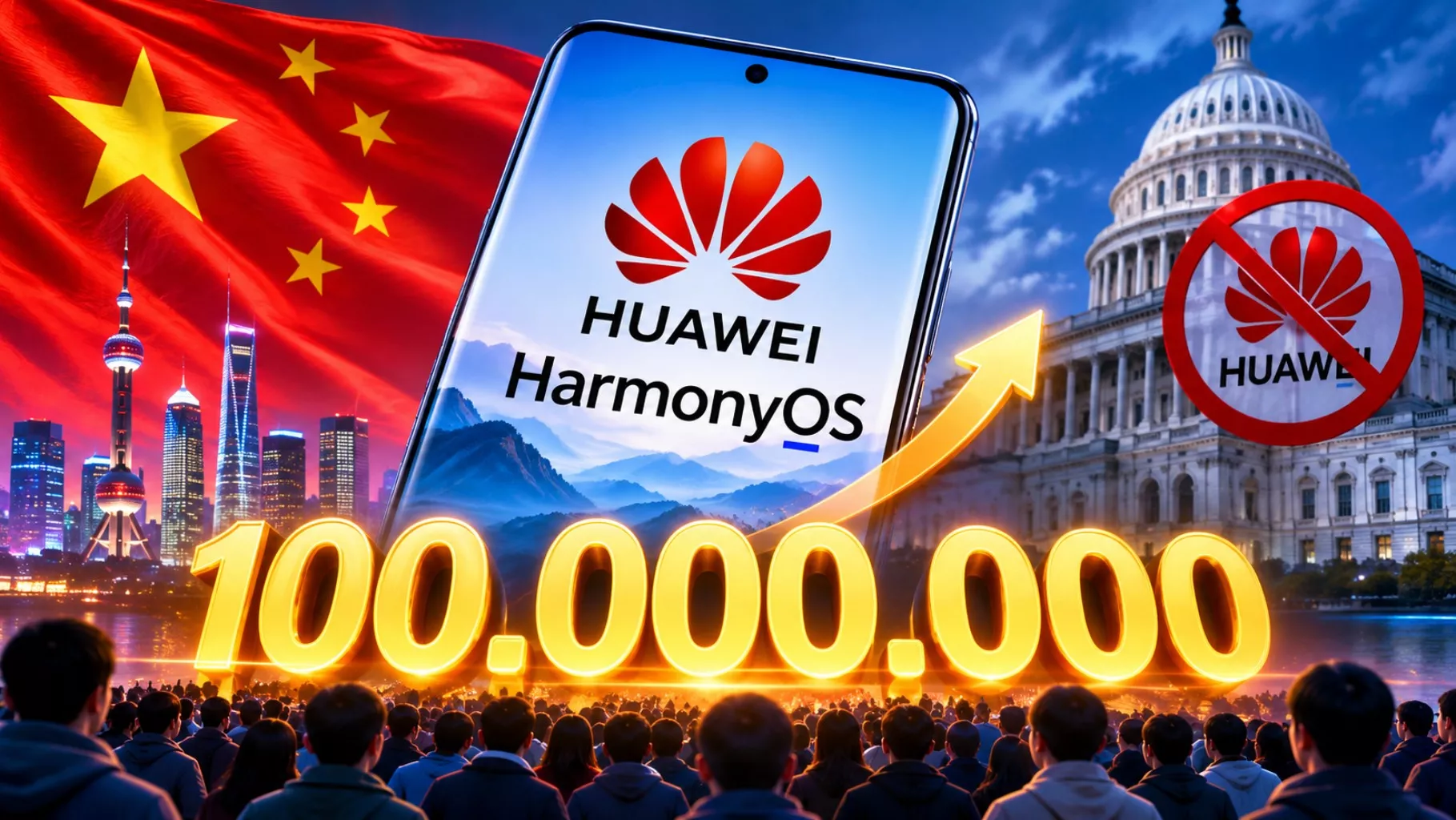
Huawei’s HarmonyOS operating system has surpassed the 100 million user mark, ranking third after Android and iOS. This milestone is the result of a continuous development of the software platform and the expansion of the compatible device ecosystem.
The ban imposed by the United States on Huawei in 2019 gave a huge boost to HarmonyOS development, turning what was initially an alternative project into an industrial priority. A decision that shows how Washington likely underestimated the long‑term consequences of its restrictions.

If technology is a tool of geopolitical power, relying on infrastructure, operating systems and platforms controlled by other nations constitutes a strategic vulnerability. China responded by investing in its own autonomy and today Huawei has built an ecosystem independent of Android and Western services. The result is a paradox: in trying to maintain technological control, the United States has helped accelerate the emergence of a Chinese alternative. Moreover, the much‑desired “backdoor” present in Chinese technologies, now on their phones (paralleling) is no longer there.
Huawei began developing HarmonyOS in 2019, initially focusing on smart electronics. Subsequently, the operating system was deployed on smartphones and tablets, then expanded to wearables and IoT devices.
A key milestone was the transition to HarmonyOS Next, also known as HarmonyOS 5. In this version, Huawei removed all AOSP libraries used for compatibility with Android‑based apps. In their place, the Chinese IT giant leaned on its own software, while third‑party developers and tech companies began actively supporting the new platform.
According to the Chinese outlet Mydrivers, the company has decided to celebrate the milestone with a special incentive program. Over 60,000 employees who contributed to the HarmonyOS ecosystem will receive honors and additional rewards for their contribution to building the proprietary platform.
Another growth factor for HarmonyOS popularity has been the recent HarmonyOS 7 release, which introduced new customization features, helping increase installations on smartphones, tablets, wearables and MateBook computers.
Huawei believes that the success of a mobile operating system depends not only on technical features, but also on the size of the user base, the developer community, and accumulated resources. For this reason, the company places particular emphasis on attracting external developers and creating apps for its devices.