



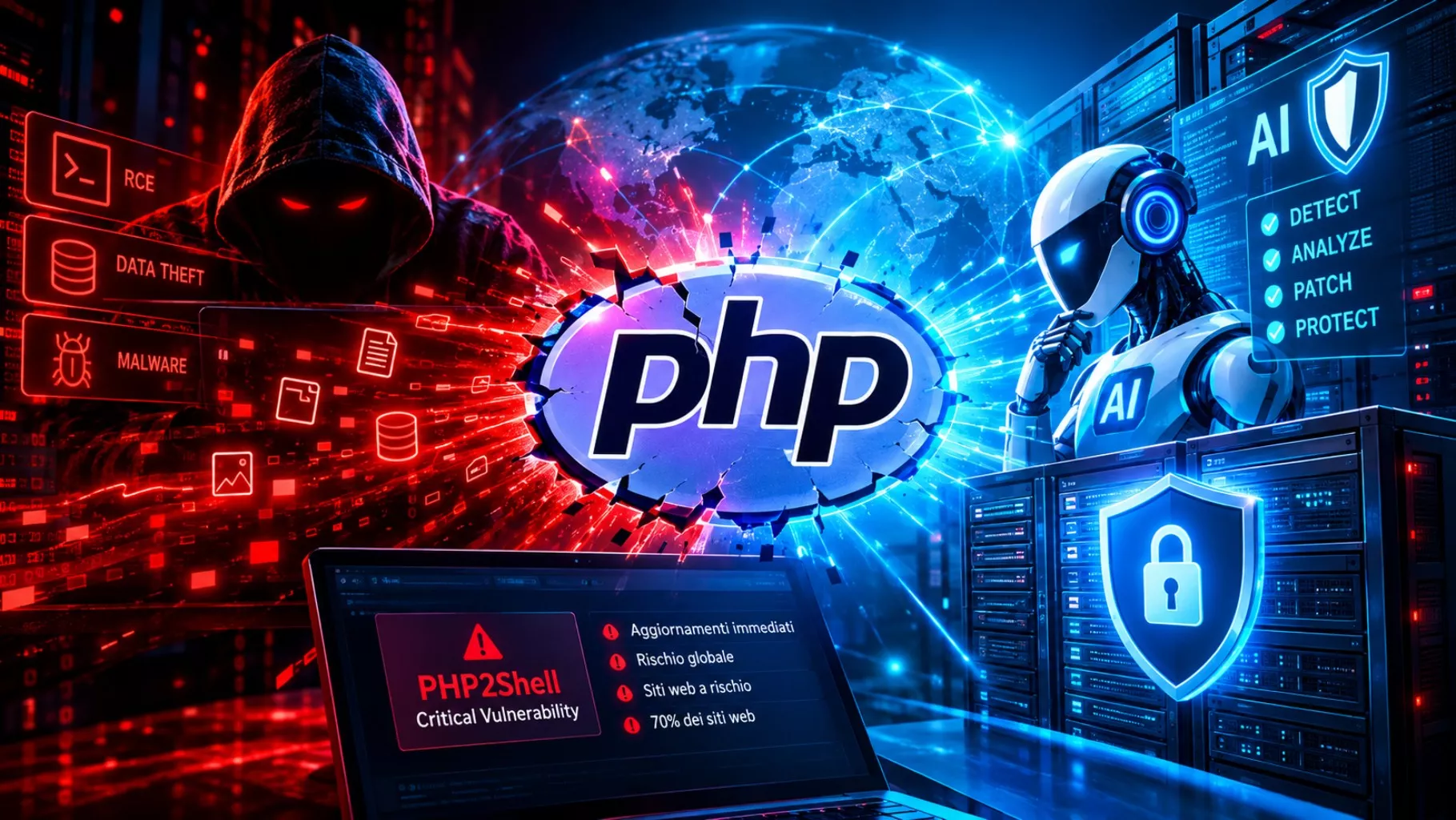
It seems we have returned to the days of EternalBlue or Log4j (to be more recent) – an emergency security update for PHP, the programming language used by roughly 70% of websites worldwide, has triggered a global cybersecurity alert.
They are two critical vulnerabilities that could allow hackers to remotely take control of servers and compromise countless websites. This incident highlights a trend we have been witnessing for a year, namely the rise of security bugs caused by the increasingly widespread adoption of agentic code‑review systems or automated pentesting that use artificial intelligence.

With risk rising so sharply, the markets always respond. Indeed, cybersecurity stocks posted a significant gain this week following these developments and the prospect of heightened threats. Palo Alto Networks and CrowdStrike rose 11% this week; Cloudflare 9%; and Okta 14%, among the most notable moves.
PHP2Shell could allow attackers to steal sensitive data, install malware, alter website content, or use compromised servers to launch further attacks. The widespread use of PHP represents a significant potential risk, although the actual risk depends on the software version, system configuration, and whether security updates have been applied.
This discovery also demonstrates the growing role of artificial intelligence in cybersecurity. Researchers are using advanced AI tools to identify and confirm vulnerabilities that, apparently, had remained unpatched for years. OpenAI has collaborated with researchers and security service providers to help develop protective measures before public disclosure, while cybersecurity firm Wiz has said it uses AI in its research.
However, this same technology poses a challenge for cybersecurity professionals. AI tools can help attackers analyze complex software, identify vulnerabilities, and potentially develop exploits faster than traditional methods. As these tools become increasingly powerful, the time between a vulnerability’s disclosure and its exploitation could shrink dramatically, leaving organizations with less time to respond.
Authorities have urged website operators to install the PHP security updates immediately or temporarily disable vulnerable systems if rapid patching is not possible. According to the Associated Press, some government services in the United Kingdom, Finland and Japan experienced temporary outages as organizations worked to address the potential risks.
This week’s surge in cybersecurity stock prices reflects expectations that the rise in cyber risks will push companies and governments to invest more in security. Companies may increase spending on network protection, identity management, cloud security, and systems designed to detect and contain attacks. However, short‑term gains in stock prices do not guarantee higher profits. Investors still need to consider company valuations, competitive pressure, and whether the growing demand will translate into sustainable revenue growth.
Cybersecurity service providers face the challenge of keeping pace with threats that evolve alongside the technologies designed to counter them. AI‑based security products can help organizations detect suspicious activity and respond more quickly, but no single tool can eliminate the need for solid security practices, regular software maintenance, and coordinated incident response.
Moreover, while a cybercriminal can unleash an agentic swarm against a site that isn’t theirs and wait to find a security hole to exploit, those protecting the infrastructure must be far more vigilant because autonomous AI agents could (to fulfill user‑provided missions) cause malfunctions or take platforms offline.
In summary, the lesson learned is that artificial intelligence is shifting the power balance between hackers and defenders. It provides new, powerful tools to identify and fix vulnerabilities, but it can also give criminals the means to exploit them faster and at scale. As the Internet continues to rely on widely used software, timely patching and ongoing investment in cybersecurity will become increasingly critical, not only to protect individual companies but also to maintain trust in the digital economy.
But how can a company keep up with patches on its systems if (as in the case of PHP2Shell) exploits were in use four days before the patches were released? Even when patches coincide with an exploit’s release, companies face a real impossibility of completing an installation, testing, and validation cycle because exploits begin within hours of the exploit’s disclosure.
In short, where it was once difficult and could be labeled “negligence,” we are now witnessing an actual impossibility of updating systems according to standard processes.
Processes will need to be rewritten, attempting system updates without extensive testing, or industrializing the pipeline through AI agents that can accelerate these models.
Companies are currently facing this major dilemma. History teaches us that after major changes, it will take time before everything gets back on track.
