


In recent months, the penetration testing landscape has been undergoing a profound and accelerated transformation. So-called agentic tools , i.e., tools capable of autonomously orchestrating multiple phases of a security assessment, are spreading like wildfire, especially within the open source ecosystem.
This evolution is the result of two main factors: on the one hand, the maturity of classic tools (Nmap, Nikto, SQLMap, Metasploit), on the other, the influence of AI models and automated workflows, which are redefining the very concept of penetration testing. The result is a new approach: less operator-centric, more process-centric .
The open source world, historically a driving force of offensive innovation, is responding with astonishing speed. After the initial embryonic experiments, structured, documented projects designed for repeatable use are now beginning to emerge.
AutoPentestX also fits into this context, which is not an “agentic” solution, but is a leap forward that consolidates a trend that is now evident.
This is where AutoPentestX comes in. It’s an open-source toolkit with a clear goal: automating the entire penetration testing cycle with a single command , while maintaining a deterministic and controllable approach. Unlike other “AI-first” tools, AutoPentestX doesn’t use external AI models , but relies on a well-defined internal logic pipeline.
The operation is completely local: AutoPentestX orchestrates established tools such as Nmap, Nikto, SQLMap, and Metasploit , collects the results, correlates them via Python modules, and enriches them with data from external CVE APIs (CIRCL/MITRE) exclusively for the vulnerability intelligence phase. There is therefore no LLM-based behavioral analysis, but a deterministic risk engine based on CVSS, exploitability, and exposure context.
This design choice makes AutoPentestX particularly attractive for enterprise environments and educational laboratories: no sensitive data is sent to AI cloud services, and there’s no “black box” decision-making. The entire process is traceable, logged, and replicable, with a strong focus on safe exploitation and controlled simulation.
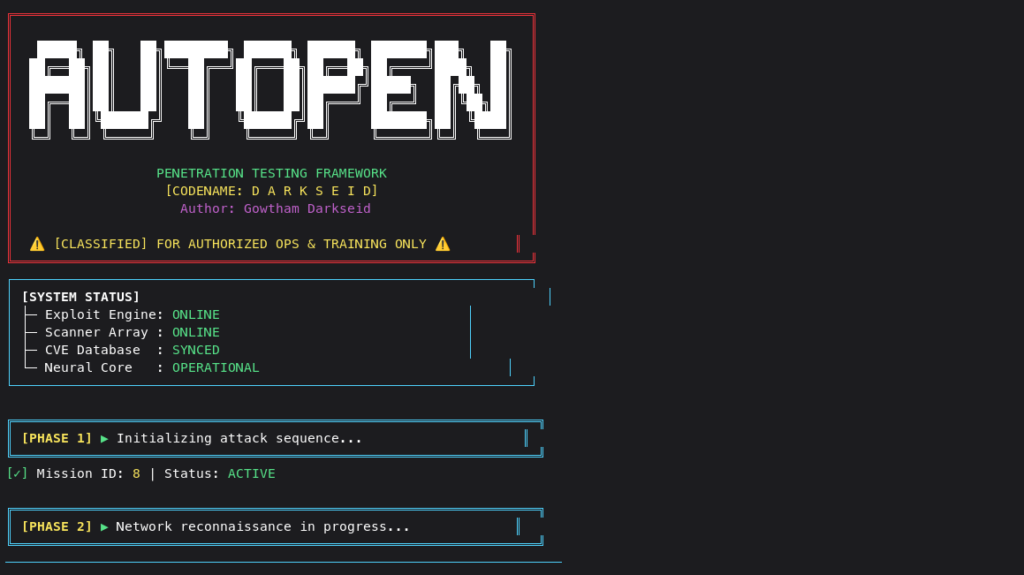
From an operational standpoint, AutoPentestX covers virtually all phases of an infrastructure and web penetration test. Starting from a single IP or domain, the tool performs automatic OS detection , complete TCP/UDP port scanning, service and version identification, and then moves on to the vulnerability detection phase.
The web component relies on direct integration with Nikto and SQLMap , while vulnerabilities are correlated with known CVEs via automatic lookups on public databases. The risk engine calculates a final score by combining CVEs, availability of public exploits, and attack surface area, classifying findings as CRITICAL, HIGH, MEDIUM, and LOW.
One of the most mature aspects of the project is reporting : AutoPentestX generates professional PDF reports with executive summaries, technical details, risk scoring, and actionable recommendations. All data is also saved in a local SQLite database, allowing for historical analysis and comparisons over time. This is where the tool truly demonstrates its production-ready nature, closer to automated vulnerability management than a simple attack script.
| Tool | Purpose | Integration |
|---|---|---|
| Nmap | Port scanning, OS detection, service enumeration | python-nmap library |
| Nikto | Web vulnerability scanning | Subprocess execution |
| SQLMap | SQL injection detection | Subprocess execution |
| Metasploit | Exploitation framework | RC script generation |
| CVE CIRCL | CVE database API | RESTful API calls |
| SQLite | Data persistence | Built-in Python sqlite3 |
| ReportLab | PDF generation | reportlab library |
AutoPentestX is not an isolated case, but yet another confirmation of a clear trend: penetration testing is increasingly becoming a process orchestration , less dependent on the individual operator’s creativity and more oriented towards repeatability. Agentic tools, with or without generative AI, are redefining the boundaries between scanning, exploitation, and reporting.
In the open source world, this evolution is particularly evident. The combination of legacy tools, advanced automation, and—in some cases—local AI models is creating a new generation of offensive frameworks. They don’t replace the pentester, but they multiply their effectiveness , especially in the most repetitive and time-consuming phases.
AutoPentestX fits perfectly into this context: no hype, no forced cloud, but a clear vision of what automated, ethical, and documentable pentesting means today. And it’s very likely that it won’t be the last project of its kind to emerge in the coming months.
While tools like AutoPentestX represent a significant advancement in penetration testing automation, it’s crucial to clarify what they can and cannot do . Otherwise, there’s a risk of confusing an automated technical assessment with a true impact test.
The first major limitation concerns context . AutoPentestX analyzes hosts, services, versions, known vulnerabilities, and possible exploits , but has no visibility into the true value of the analyzed system. It doesn’t know the target’s role in the business, the criticality of the data processed, or the operational consequences of a compromise . A vulnerability with a high CVSS may be irrelevant in an isolated and devastating production environment: for the tool, however, the risk remains purely technical.
A second crucial limitation is the lack of concrete proof of impact . Even when critical vulnerabilities or potentially exploitable exploits are identified, AutoPentestX operates in ” safe ” mode, without carrying out actual attacks. It does not gain access, does not compromise accounts, and does not demonstrate exfiltration or lateral movement. Consequently, the impact always remains hypothetical: what is measured is the theoretical possibility of an attack, not the damage that can actually be caused.
Then there’s the issue of the kill chain . Automated solutions work in linear, statically correlated phases: scanning, enumeration, vulnerability detection, and matching with known exploits. However, they lack the ability to construct complex attack chains, combining minor vulnerabilities, misconfigurations, trust relationships, and logical weaknesses. It’s precisely in these chains that the most serious attacks often hide, the ones a human pentester can identify by reasoning like a real attacker.
Finally, the use of standard metrics like CVSS , while correct and useful, introduces a further simplification. CVSS measures the technical severity of a vulnerability, not the actual risk to a specific organization. It doesn’t take into account existing mitigations, detection capabilities, incident response procedures, or the actual exposure of the asset. Again, the result is a score that’s useful for structuring, but insufficient to guide strategic decisions.
In short, tools like AutoPentestX shouldn’t be interpreted as a replacement for manual penetration testing or red teaming. They are accelerators , excellent for reducing noise, especially when used during the testing phase of solutions in DevSecOps environments, standardizing checks, and quickly identifying obvious problems.
But the analysis of the real impact, the one that answers the question “what could really happen if this system is compromised?”, still remains – and probably will remain for a long time – a human responsibility.
Follow us on Google News to receive daily updates on cybersecurity. Contact us if you would like to report news, insights or content for publication.