


Hi guys,
My name is Giorgio , I’m 58 years old, I’ve always worked as an administrative technician, and in life, I’ve always been the ” rational ” one in the family. The one who checks the accounts, who doesn’t trust strange phone calls, who tells everyone “don’t click links, don’t answer unknown numbers.”
Yet today I’m here, with you, not because I clicked the wrong link… but because I couldn’t stop a scam that was eating my father away .
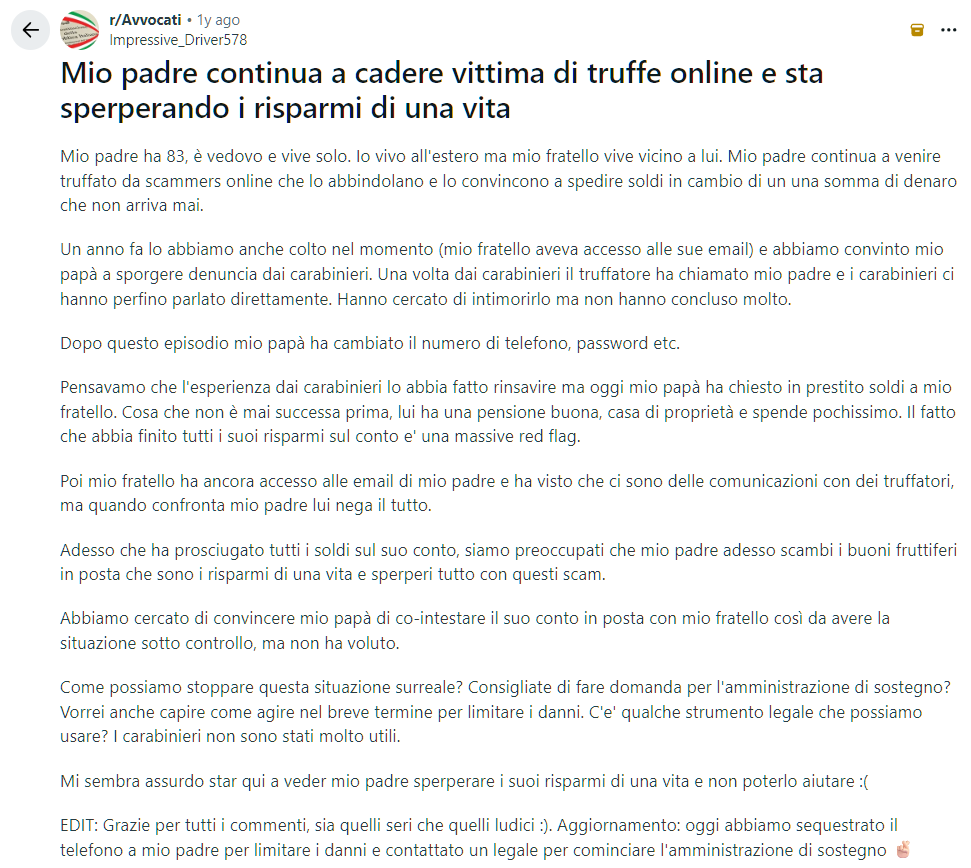
My father is 83 years old. He’s a widower, lives alone, and is proud and stubborn, as only a person of his generation can be. He’s always managed his money carefully: a more than decent pension, his own home, few expenses, and a balanced life .
I live abroad, my brother lives nearby and helps him with practical things from time to time.
It all started almost invisibly. A few ” strange ” emails, a few phone calls that he would dismiss with a “it’s the bank” or “someone who needs to help me unlock some money.”
At first, we didn’t give it much thought. Then, a year ago, we caught him red-handed : my brother had access to his emails and saw constant exchanges with so-called intermediaries, consultants, and benefactors. Promises of huge sums in exchange for small advances. A classic textbook scam.
We convinced him to report it.
We went to the Carabinieri. One of the scammers even called while we were there. Veiled threats, attempts at intimidation. But, in the end, nothing concrete. A change of number, new passwords, and the feeling— mistaken —that it was all over.
It wasn’t over at all.
A few months later, my father started acting strangely. He asked my brother to borrow money. He’d never done that in his life. Never.
That’s when we realized something wasn’t right. We checked our emails again: the scammers were back . Or maybe they’d never left.
When we confronted him, he denied everything. It was a classic pattern: denial, minimization, silence. As if admitting the scam was worse than the scam itself.
Meanwhile, the account was practically empty. Life savings evaporated in bank transfers, top-ups, and promises of “final payments ” to unlock sums that never existed.
The biggest fear, at that point, wasn’t even the current account. It was the next step: postal savings bonds , the last lifeline.
We tried asking him to co-sign the account.
Total refusal.
Pride.
Fear of losing control.
Fear, perhaps, of admitting that I no longer have it.
In the end, we did the hardest thing: we confiscated his phone to limit the damage and contacted a lawyer. Administration of support. A word that weighs like a millstone, but sometimes it’s the only way to save a person… even from themselves.
That’s why I’m here.
Not as a direct victim of phishing, smishing, or vishing.
But as a collateral victim of a long-term scam , built on loneliness, age, trust and shame.
I’m here because silence is the scammers’ best ally .
Because every untold story becomes a manual for those who exploit the fragility of others.
Because shame doesn’t protect, it isolates.
And isolation is fertile ground for those who promise help, profits, miracle solutions.
I’m here because sharing isn’t exposing a weakness, but breaking a spell .
It’s taking power away from those who live in the shadows, those who build castles of lies brick by brick, taking advantage of those who are least equipped to defend themselves.
Telling these stories serves to leave traces, signals, collective antibodies.
It’s there to tell anyone who’s going through the same thing: you’re not stupid, you’re not alone, it’s not your fault .
It serves to remind us that behind every scam there are not just numbers, but families that break up, trusts that crack, dignity that is slowly eroded.
If even just one person, reading these words, recognizes a warning bell before it’s too late, then this sharing will have made sense.
Because true prevention doesn’t come from systems, codes, or algorithms.
It comes from the courage to tell what hurts.
Giorgio’s story teaches us some fundamental things:
It is possible to predict all of this by observing the weak signals: requests for secrecy, promises of unrealistic earnings, requests for “advances”, isolation from family, refusal to engage in dialogue.
Modern scams don’t hack computer systems.
They pierce people.
And when that happens, it’s not enough to say “I told you so.” You have to take action. Even when it hurts.
The article was inspired by a real scam shared by a user on Reddit.
Our deepest consolation goes to this person: her courage in sharing her experiences allows others to recognize the signs, protect themselves, and learn from her experiences.
Follow us on Google News to receive daily updates on cybersecurity. Contact us if you would like to report news, insights or content for publication.