
Red Hot Cyber
Cybersecurity is about sharing. Recognize the risk, combat it, share your experiences, and encourage others to do better than you.
Search
320x100 Itcentric
UtiliaCS 970x120

Tag: dark web

Apple in the crosshairs: alleged data breach of the Cupertino giant published on XSS

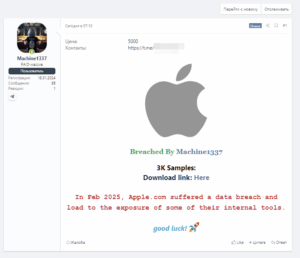
May 14, 2025 – In the early hours of this morning, an alarming post appeared on the Russian underground forum XSS , known to be a leading showcase for the buying and selling of compromised data: the Machine1337 group claimed responsibility for an alleged breach of Apple.com’s internal systems. The post, accompanied by the logo of the famous company and signed “Breached by Machine1337”, indicates that in February 2025 Apple would have been the victim of a data breach that would have led to the exposure of internal tools. According to what was declared by the malicious actor, 3,000 files were stolen, offered in samples with a download link. The entire package is put on

VanHelsing RaaS: An Expanding Ransomware-as-a-Service Model

The ransomware threat landscape is constantly evolving, with increasingly structured groups adopting sophisticated strategies to maximize profits. VanHelsing is a new player positioning itself in the Ransomware-as-a-Service (RaaS) market, a model that enables even cybercriminals with limited expertise to conduct advanced attacks using an automated platform. Following the February 23, 2025 announcement on an underground forum regarding the VanHelsing RaaS affiliate program, the ransomware group has officially published its first possible victim on its Data Leak Site (DLS). Less than a month after its launch, the appearance of the first compromised organization confirms that VanHelsing is now actively operating. Although the DLS

Babuk Locker 2.0: The New Ransomware Affiliate Program

Babuk, one of the most notorious ransomware groups in cybercrime, has launched the Babuk Locker 2.0 Affiliate Program 2025, an affiliate program for skilled hackers looking to profit from ransomware attacks. This program, published on their data leak site, introduces new advanced features and a more structured model for those wishing to join their criminal network. How the Program Works Babuk Locker 2.0 accepts affiliates from all over the world, regardless of language or origin, provided they have experience in penetration testing and compromising IT systems. Their goal is clear: maximize profits through targeted attacks and manage ransom payments more efficiently. The

NightSpire: A New Player in the Ransomware Landscape

During our reconnaissance into the underground world and criminal groups conducted by Red Hot Cyber’s threat intelligence laboratory DarkLab, we stumbled upon a Data Leak Site of a cyber gang never monitored before: NightSpire. NightSpire is a new ransomware group that has recently emerged on the cybercrime scene. Although no previous information is available about this actor, an analysis of their data leak site (DLS) and their communication provides some key insights into their strategy and operational methods. The group portrays itself as an unstoppable threat to businesses and promises to exploit every vulnerability to their advantage. Below, we analyze the details

Akira Ransomware: The New Threat Using Webcams as Entry Points

Akira represents one of the most recent ransomware threats capable of bypassing traditional organizational defense mechanisms. A recent case analyzed by the S-RM team highlighted how this group leveraged an unprotected webcam to deploy its payload, evading the defenses of an Endpoint Detection and Response (EDR) system. The Initial Modus Operandi The attack began with the compromise of the victim’s network through an internet-exposed remote access solution. Once inside, Akira deployed AnyDesk.exe, a remote management tool, to maintain control over the environment and proceed with data exfiltration. During the later stages of the attack, the attackers used the Remote Desktop Protocol (RDP)

Possible breach at Ukraine’s Ministry of Foreign Affairs: the Qilin Ransomware group claims responsibility for the attack

The Qilin Ransomware group claims to have compromised the systems of Ukraine’s Ministry of Foreign Affairs, stealing private correspondence, personal information, and official decrees. According to the attackers, some of this data has already been sold to third parties. At the moment, it is not possible to confirm the veracity of these statements because the organization has not yet released any official press statement on its website regarding the incident. Consequently, the information presented in this article should be treated solely as an intelligence source. Details of the Alleged Breach Status of the Investigation Conclusions At present, the alleged breach claimed by

Analysis of Recorded Future’s CVE Report – February 2025

The monthly Recorded Future CVE report for February 2025 provides a detailed overview of current cybersecurity threats, highlighting a slight decline compared to the previous month. A total of 25 high-impact vulnerabilities were identified, down from 33 in January, yet the overall risk level remains high. Several of these vulnerabilities are already being actively exploited by cybercriminals, making a timely response from corporate security teams essential. One of the key aspects of this report is the ability to analyze the issue from two complementary perspectives: that of CEOs and that of IT managers and CISOs. On one hand, business leaders must understand

Ransomware Gangs weaponize Windows Defender Application Control (WDAC) to disable EDR products.

In the past days we saw that Ransomware Gangs use WDAC to disable EDR products. I have known this type of attack for a year when a guy posts a similar technique on Twitter, but this is the first time that was used in Ransomware Attacks. So, it’s time to explain how it works and how to check it. First, the WDAC is a feature of Microsoft that is very similar to App Locker. We need to download Application Control Wizard from Microsoft webpage. After we install it, we can open it and define the policy. Here we can do two things,

The Exploit for the RCE on Palo Alto Firewalls is now Online! And let the Administration be for all

A few hours ago on Breach Forum, a threat actor by the name “newplzqibeme” shared a GitHub repository where a python-written exploit for active exploitation of CVE-2024-0012 on PanOS (the Palo Alto firewall operating system) is published. The exploit grants the attacker, full administrative access to the firewall with an Authentication Bypass mechanism, gaining administrator access. The post by “newplzqibeme” shows two public IPs as examples, which are most likely exposed and vulnerable firewalls. Firewalls running PanOS 10.2, 11.0, 11.1 and 11.2 are affected by this CVE if not upgraded to the respective versions (>= 10.2.12-h2, >= 11.0.6-h1, >= 11.1.5-h1 and >=

RHC DarkLab Interviews Interlock Ransomware. “Don’t waste your energy and time. We will do it for you.”

RHC DarkLab has always taken a unique and provocative approach in the fight against cyber threats, summed up by the motto: ‘One must know the Demons to learn how to counter them.’ This philosophy guides our ongoing commitment to understanding Threat Actors through face-to-face interviews to expose their techniques, tactics and procedures (TTPs) and improve the defences of those facing these insidious adversaries. Cyber gangs, such as Interlock, often present themselves with a mix of highly sophisticated motivations and skills, as demonstrated by recent attacks targeting seemingly secure systems such as FreeBSD. In many cases, they claim to act to fill gaps