

The accelerated growth of artificial intelligence is bringing with it an increasingly obvious consequence : rising energy demand. This issue entered the US political debate forcefully on January 13, when President Donald Trump took to Truth Social to criticize the role of large tech companies in increasing household bills.
According to Trump, the expansion of large data centers has directly contributed to rising electricity costs for households. The president has cited average price increases exceeding 30% in recent times, attributing the blame both to the current stage of AI development and to the policies of the previous administration . Hence his explicit request to Big Tech to achieve energy “self-sufficiency,” preventing the costs from being passed on to taxpayers.
In his speech, Trump reiterated the need for the United States to maintain global leadership in artificial intelligence, recognizing data centers as strategic infrastructure. At the same time, he clarified that citizens should not be responsible for the costs of their electricity . The president also announced new government initiatives on the issue in the coming weeks.
Microsoft was the first major technology company to officially respond to this policy. The company announced its intention to fully cover the infrastructure costs associated with its energy needs, committing not to pass any burden on to local communities. Shortly after the president’s statements, Microsoft Vice President and President Brad Smith released a policy document entitled “Building Community-First AI Infrastructure “ .
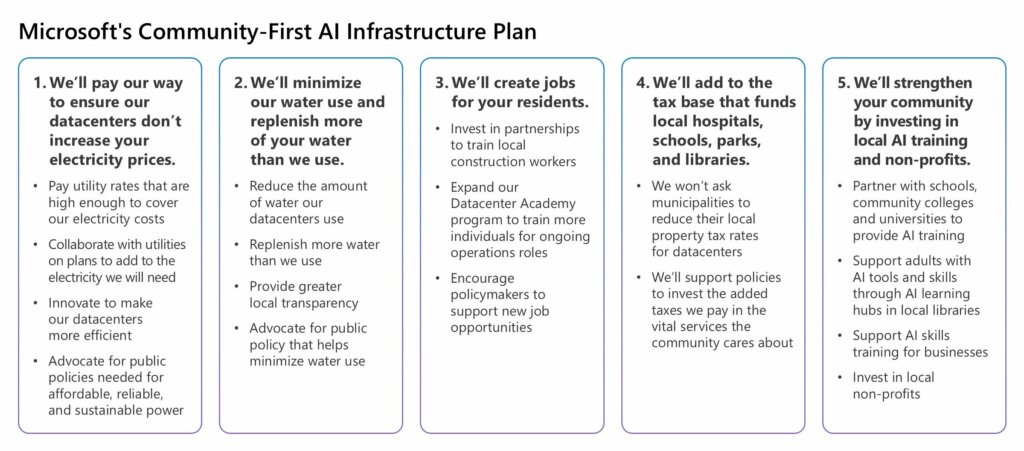
The plan outlined by Microsoft is structured in five points and revolves around a central principle: self-financing . The company announced that it will work with utility providers to ensure that the electricity rates charged to data centers fully cover additional operating costs. This way, any increased costs will not be passed on to residential customers.
Alongside this commitment, Microsoft has outlined other lines of action. These include more transparent and timely cooperation with utilities to manage peak demand, the adoption of technological solutions to improve data center energy efficiency, particularly in terms of PUE, and support for legislative initiatives at the state and federal levels aimed at ensuring reliable and affordable electricity supplies for communities.
The company’s decision was also informed by recent experiences. In October 2025, a $7 billion project to build a 0.9 gigawatt data center in Wisconsin was blocked after strong local opposition, specifically related to electricity cost sharing. This incident highlighted the growing sensitivity of local communities to the energy impact of digital infrastructure.
The overall context is characterized by what many observers are calling ” energy anxiety” linked to artificial intelligence. According to estimates by the International Energy Agency , electricity demand from data centers in the United States could triple over the next decade, putting pressure on an already obsolete electricity grid.
Even Microsoft’s top management has acknowledged the problem. In previous statements, CEO Satya Nadella emphasized that the main limitation to AI development is not the availability of computing power, but the difficulty of the electrical infrastructure to sustain growth. Without sufficient power, he noted, even the most advanced chips remain unused.
For the Trump administration, the issue represents a complex balancing act. On the one hand, support for deregulation and the industrial development of AI; on the other, the risk that rising energy prices will fuel inflation and voter discontent, with possible repercussions for the midterm elections scheduled for November.
In the past, large tech companies have often benefited from preferential rates or agreements with local authorities in exchange for investments and promised jobs. However, with data centers operating on a gigawatt scale, consumption has become so high that it directly impacts the stability and prices of the residential electricity grid. Microsoft’s stance therefore marks a potential paradigm shift for the entire sector.
The global competition for artificial intelligence is increasingly turning into a competition for energy access. Building new data centers now means being prepared to finance new production sources or face high energy costs. This dynamic could weigh on other giants like Google, Amazon, and Meta, but could also accelerate the adoption of advanced solutions, from small modular reactors to renewable energy technologies, within the tech industry.
Follow us on Google News to receive daily updates on cybersecurity. Contact us if you would like to report news, insights or content for publication.