

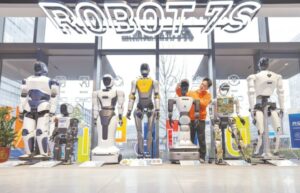
At ten o’clock in the morning, in Wuhan, two 1.3-meter-tall humanoid robots begin moving with precision. They turn, jump, and follow a rhythm. It’s the opening signal for the country’s first 7S humanoid robot store, a debut that seems like something out of a movie but is already a reality.
The initiative isn’t just a commercial experiment: it also represents a step forward in consumer robotics, with machines capable of social tasks, assistance, and entertainment. According to experts, this model could become a precursor to the stores of the future, where human-robot interaction will be the norm.
The concept is reminiscent of 4S car dealerships, but here the focus is on embodied intelligence . In the store, robots of various sizes are engaged in various activities: some play soccer, some sell products, some play music for curious visitors.
A total of 17 humanoid robot models are on display, with prices ranging from 7,999 to 700,000 yuan. According to director Hu Longdan, they can be used in over ten scenarios, from industrial production to cultural tourism, healthcare, and special operations.
The 7S store integrates seven functions: sales, spare parts, after-sales service, informative feedback, solutions, demonstrations, and training. It thus covers the entire industrial supply chain, from components to complete machines, right down to concrete application scenarios.
At the entrance stands ” Yuanyou ,” a 158-centimeter-tall, 72-kilogram humanoid robot on wheels. It can walk at a speed of 1.5 meters per second and has already been operational for nine months at Xianning Central Hospital, providing patient care and information services.
Yuanyou is the first humanoid robot used in a hospital in Hubei province. Before its creation, the development team analyzed customer needs, creating hardware, software, and algorithms that were then assembled into a complete system.
The development was led by Wuhan Shouzhi Innovation Technology Co., Ltd., with academic support from Wuhan University of Sensors and Artificial Intelligence. Over 80% of the hardware comes from the local supply chain, comprising 20 major companies and nearly 1,000 related entities.
From research to production, it took just six months. The first Yuanyou was born in April 2025, and today the company has four automated lines, with an annual capacity of 1,500 units, marking its entry into mass production.
To make the robots truly operational, Hubei established the Humanoid Robot Innovation Center in June 2025. Here, hundreds of robots are trained in realistic and temporary scenarios and generate over a million real-world data points each year.
Wuhan has supported the process with a three-year action plan and financial incentives for concrete applications. The results are beginning to show: the 7S store has already exceeded 600,000 yuan in revenue, reflecting the growth of Hubei’s humanoid robot ecosystem.
Follow us on Google News to receive daily updates on cybersecurity. Contact us if you would like to report news, insights or content for publication.