When Rome’s tarmac sends Autopilot into a tailspin: the case of Nello Coppeto on the Giovanni XXIII Tunnel
Today I’d like to share a story that happened to one of my LinkedIn contacts, which makes us reflect on the peace of mind you might feel when driving your Tesla, BYD, LeapMotor or other BEV along one of our Italian city streets or avenues with the standard Autopilot engaged. What I am about to describe happened on a busy road in Rome, the Galleria Giovanni XXIII.

You are relaxed, minding your own business; your family or work worries are keeping you mentally occupied, when, suddenly, your car decides on its own to swerve towards the vehicle next to you. In such cases, quick reflexes are certainly a great help.
This is exactly what happened to Nello Coppeto, Head of the Giotto Cyber Suite Lab; Nello shared his experience on LinkedIn, recounting it with some pertinent reflections …
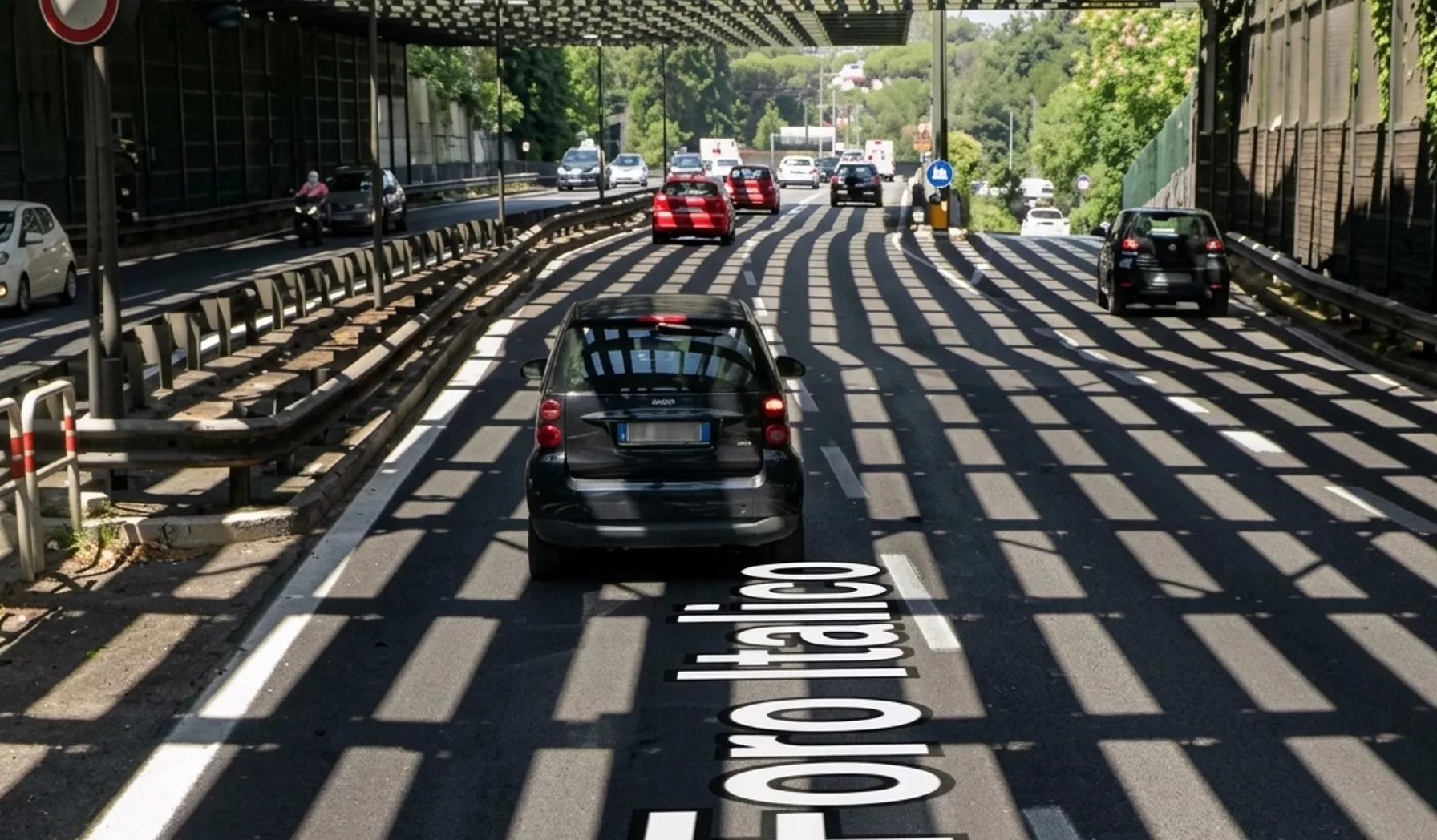
But what caused the sudden, uncontrolled swerve? The cause, or rather ‘the culprit’, was right above Nello’s head – not in a metaphorical sense, but in a physical, literal sense: the metal grating covering the tunnel, designed between 1999 and 2004, casts a pattern of parallel shadow stripes onto the tarmac, perpendicular to the direction of travel. For us living beings, Italians in particular, accustomed to living with all manner of infrastructure decay and damaged tarmac, it is simply ‘a pattern on the concrete’. For the computer vision electronics of modern driver-assisted cars, trained to recognise lane markings, those shadows are a perfect trap, a sort of deception: the system interprets them as road markings, gets confused, and decides to swerve. The consequences can be truly serious.
Let us now consider Nello’s reflections, who not only recounted the incident but also posed three questions:
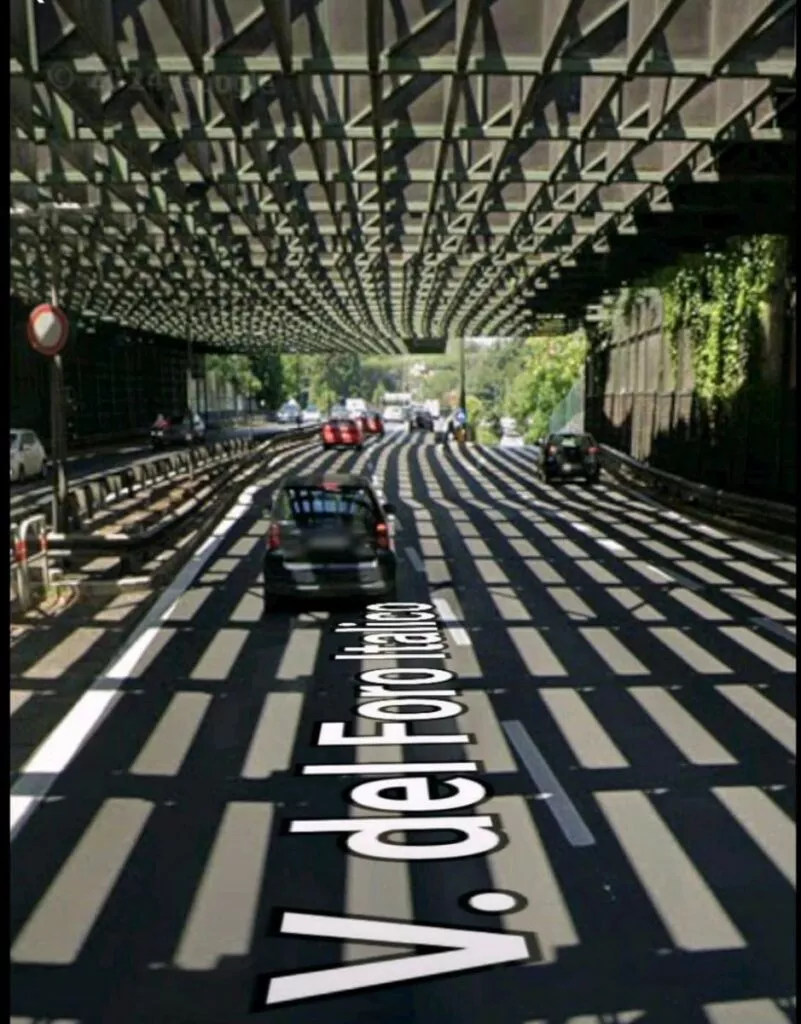
Picture taken from Nello Coppeto LinkedIN post
The main issue raised by Coppeto is very clear: we are using cutting-edge artificial intelligence on infrastructure that is poorly designed, perhaps even for human use. The Giovanni XXIII Tunnel is not the only case: in Italy, there are other structures such as bridges, tunnels, crash barriers and signage installations that exhibit oddities or anomalies.
The underlying technical problem is nothing new to industry experts. Systems based exclusively on cameras, such as Tesla Vision – adopted by Elon Musk’s company after it abandoned radar in 2021 – are vulnerable to shadows, reflections and optical illusions, which can cause the driver-assistance system to malfunction: the shadow stripes created by the Roman-style grating in the Rome tunnel are a classic example of what experts call an ‘edge case’: borderline situations that machine learning models have never analysed during their training; in such cases, incorrect decisions are made that can be dangerous.
Overpasses, hills, sharp shadows and closely spaced lane markings can confuse the logic behind lane-keeping and collision-avoidance systems, causing slowdowns, unnecessary manoeuvres or general traffic problems. In the Coppeto scenario, the system did not brake, but swerved; behaviour that is perhaps more unpredictable and potentially risky in a busy urban tunnel.
Nello also mentions legal issues … Tesla’s Autopilot, for example, is classified as an SAE Level 2 system: assisted driving, not autonomous driving. In short, the driver is always and in all circumstances responsible. Tesla makes this clear, requires drivers to accept it by signing a waiver, and repeats it every time the system is activated. Consequently, if the car were to swerve and injure someone, civil and criminal liability would fall, at least initially, on whoever was sitting in the driver’s seat behind the wheel.
What may seem strange is that the word ‘Autopilot’ makes many people think of aeroplanes or cars that drive themselves, whereas, as things stand, Autopilot is a feature that requires the constant attention of the human behind the wheel.
The Coppeto incident is not the first of its kind, and it will most likely not be the last. On 1 July 2021, on the motorway towards Loano, a Tesla Model 3 with Autopilot engaged crashed at 130 km/h into a van that had overturned on the carriageway. On-board data showed that there was no deceleration prior to the impact: the system simply failed to detect the obstacle.
A Guardian investigation published in April 2024 revealed the findings of three years of NHTSA investigations: the Autopilot system was involved in at least 13 fatal accidents between 2021 and 2023, with numerous other accidents resulting in injuries.
As for ‘phantom braking’, sudden braking in the absence of any real danger, the situation is no better. In Germany, the KBA launched a specific investigation into the phenomenon in 2025, and in Italy too, numerous users report similar experiences on dedicated forums.
Academic research has also addressed the issue: recent studies have shown that patterns of artificial shadows projected onto the road surface can be used as actual attacks on autonomous vehicles’ lane-detection systems, causing them to swerve off the road with a very high success rate (over 90%) at speeds above 10 mph.
Nello Coppeto concludes his post by suggesting that it might be advisable to fit cars with additional sensors to prevent the dangers associated with the limitations of computer vision alone. Perhaps Tesla’s decision to abandon radar in favour of Tesla Vision alone was purely economic, given that it reduced production costs, but this has resulted in the system being more vulnerable to scenarios of visual ambiguity, such as those created by the shadows of a grating built in Rome during the 1990s. When we talk about autonomous and assisted driving, we are not just considering a technological issue: the matter should be assessed in a more holistic, 360-degree manner. These scenarios require adequate road infrastructure, rigorous type-approval, clear responsibilities and, above all, an awareness of how an algorithm, however sophisticated, is not yet capable of coping with our famous Italian chaos.
📋 List of Sources
| # | Title | Source topic | URL | Date |
| 1 | AGI – Tesla crash in Italy highlights the limitations of Autopilot Tesla Model 3 accident on the motorway towards Loano, 2021 | AGI – Tesla crash in Italy highlights the limitations of Autopilot Tesla Model 3 accident on the motorway towards Loano, 2021 | https://www.agi.it/estero/news/2022-07-17/schianto-tesla-italia-limiti-autopilota-17452834/ | July 2022 |
| 2 | Il Fatto Quotidiano – Tesla’s autonomous driving system under scrutiny Guardian investigation: 13 deaths involving Autopilot between 2021 and 2023; German KBA investigation 2025 | Il Fatto Quotidiano – Tesla’s autonomous driving system under scrutiny Guardian investigation: 13 deaths involving Autopilot between 2021 and 2023; German KBA investigation 2025 | https://www.ilfattoquotidiano.it/2025/07/08/tesla-guida-autonoma-sotto-accusa | July 2025 |
| 3 | Panorama – Fatal Tesla crash: Musk to pay damages The Walter Huang case: Tesla’s first plea deal; debate on semi-autonomous driving | Panorama – Fatal Tesla crash: Musk to pay damages The Walter Huang case: Tesla’s first plea deal; debate on semi-autonomous driving | https://www.panorama.it/tempo-libero/tecnologia/incidente-autopilot-tesla-musk-patteggia | April 2024 |
| 4 | Tesla Club Italy – Liability for the fatal crash involving Tesla’s Autopilot The Joshua Brown case (2016): the first documented fatal Autopilot crash | Tesla Club Italy – Liability for the fatal crash involving Tesla’s Autopilot The Joshua Brown case (2016): the first documented fatal Autopilot crash | https://www.teslaclub.it/la-responsabilita-dell-incidente-mortale-con-il-pilota-automatico-tesla.html | October 2016 |
| 5 | PimpMyEV – Phantom Braking in Tesla Autopilot: Why It’s Still a Problem in 2025 | Tesla Vision e vulnerabilità a ombre/illusioni ottiche; frenate fantasma | https://pimpmyev.com/en-it/blogs/speed-style-carbon-fiber/phantom-braking-in-tesla-autopilot | July 2025 |
| 6 | Recharged.com – Tesla Phantom Braking Fix: Practical Guide for 2026 | Ombre, cavalcavia e strisce ravvicinate come trigger di phantom braking | https://recharged.com/articles/tesla-phantom-braking-fix | 2026 |
| 7 | TESMAG / TeslaAccessories – Why Does Tesla Autopilot Show False Positives? | Illusioni ottiche, riflessi e falsi positivi nei sistemi ADAS Tesla | https://www.teslaacessories.com/blogs/news/why-does-tesla-autopilot-show-false-positives | February 2025 |
| 8 | Moveo/Telepass – Tesla: accidents in 2024, highest rate among cars Statistical analysis of Tesla accident rates vs the US national average | Moveo/Telepass – Tesla: accidents in 2024, highest rate among cars Statistical analysis of Tesla accident rates vs the US national average | https://moveo.telepass.com/tesla-tasso-incidenti-piu-alto-2024/ | March 2025 |
| 9 | arXiv – Discovering New Shadow Patterns for Black-Box Attacks on Lane Detection Academic research: shadow pattern attacks on lane detection systems | arXiv – Discovering New Shadow Patterns for Black-Box Attacks on Lane Detection Academic research: shadow pattern attacks on lane detection systems | https://arxiv.org/pdf/2409.18248 | 2024 |
| 10 | HDMotori – Tesla publishes new Autopilot safety data Official Tesla Q1 2024 statistics: 1 accident per 7.63 million miles with Autopilot | HDMotori – Tesla publishes new Autopilot safety data Official Tesla Q1 2024 statistics: 1 accident per 7.63 million miles with Autopilot | https://www.hdmotori.it/tesla/articoli/n583805/tesla-pubblica-nuovi-dati-sicurezza-autopilot/ | May 2024 |