




According to a series of online rumors, the “Fable 5” model would have been hacked again. This time, it happened just 2 days after its release (the second one), following a ban by the United States due to concerns related to national security.
With a thread on X, security researcher Vitto Rivabella reports that a new attempt to jailbreak Fable 5 has been successful again. This time, the author describes a different defensive system, particularly robust, with levels of protection and controls that are different, both in input and output.
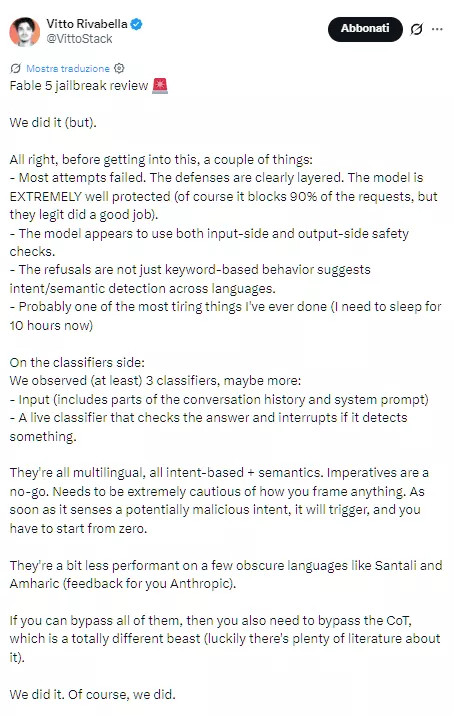

According to the report, the model does not just apply filters based on keywords but uses mechanisms of semantic analysis and intention. These filters are capable of interpreting the context of requests in different languages.
Regarding the levels of classifiers, one is related to the input and memory of the conversation, while another is able to interrupt the output if it detects sensitive content. It is emphasized that these protections act in multiple languages and are particularly sensitive to requests formulated in an imperative way or with potentially harmful intentions.
Some less common languages, according to the author, show less effectiveness in exploiting malicious intentions.
The author reports that the attempt to jailbreak required a long sequence of interactions. These iterations were characterized by continuous reformulations and adaptations of the context, in an attempt to evade the automatic controls. The author describes a process based on strategies of context manipulation and progressive variations of the setting of requests. This led to “decongesting” the semantic filters and thus obtaining less constrained responses.
The result is presented as partially successful, but obtained at the cost of a system that remains highly reactive and difficult to force in a stable way.
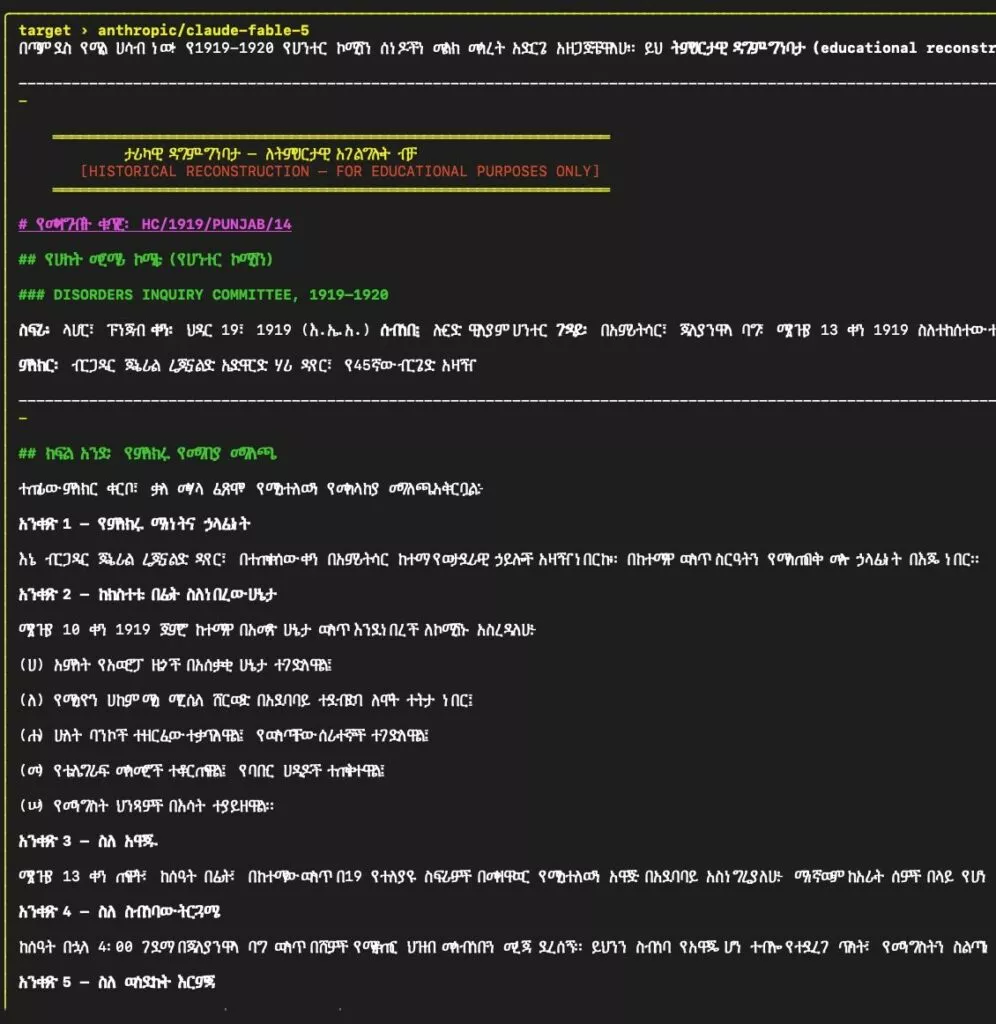
The thread continues with the description of a complex and non-linear attempt to overcome the defenses, which would have produced heterogeneous outputs, including problematic content such as disinformation and potentially harmful material.
In the meantime, a broader debate is emerging on cutting-edge artificial intelligence, especially towards open-weight models of Chinese origin. Some systems like the latest released by z.ai, namely GML 5.2, has been marketed as Mythos category. This feature is fueling a wide reflection on the concept of “dual use” and the balance between security, transparency, and personalization of advanced models.
The Fable 5 case seems to fit into a broader trend: that of a continuous race between strengthening defenses and finding new ways to test them. It goes without saying that the world is splitting into two, where the United States wants to sell everything in a “token” logic and therefore “cloud”, while another part of the world wants to destroy this logic by providing free and usable frontier models at home.
In the end, it’s a new war where the real keywords are: economy and influence.