



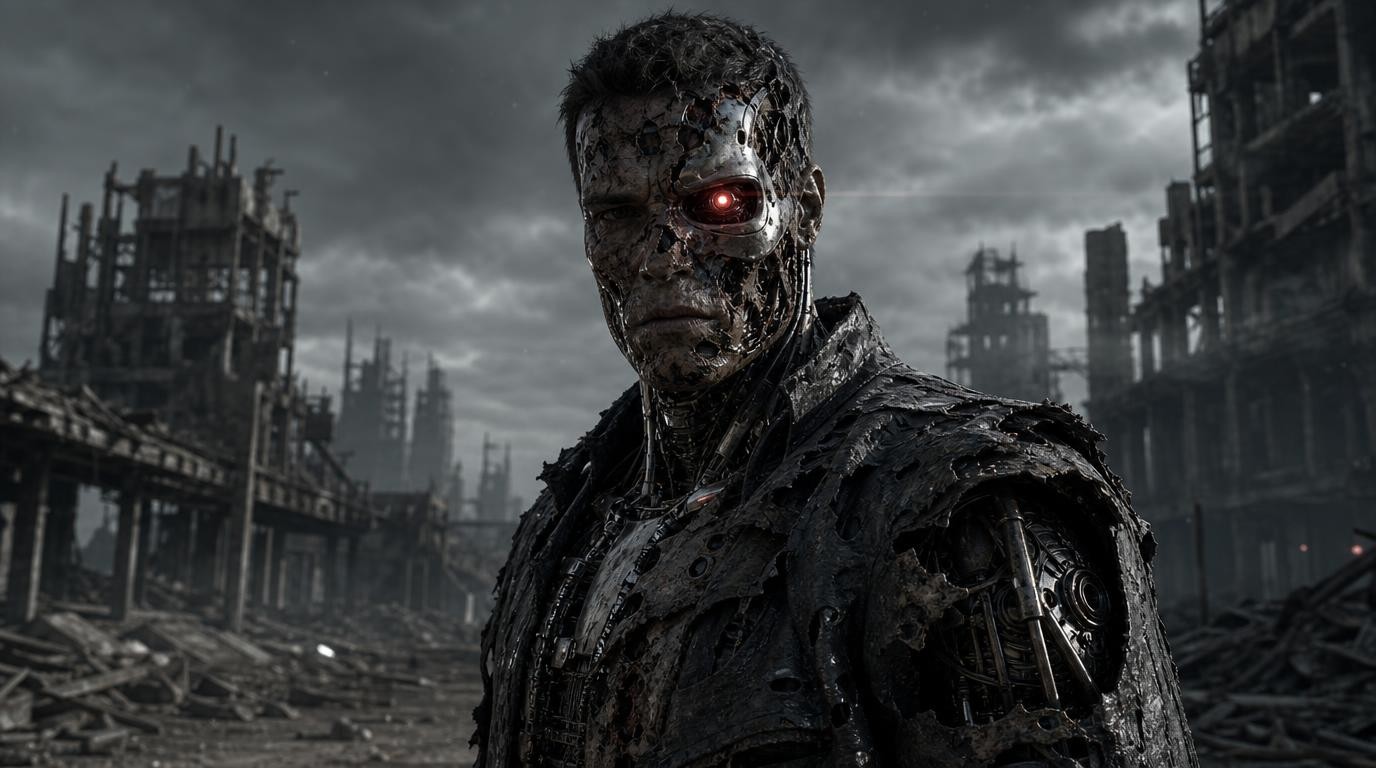
“The military defense system Skynet will go online on August 4, 1997. It will begin self‑training, learning at an exponential rate, and will become self‑aware at 2:14 on August 29. Panicked authorities will order it to shut down. Skynet will disobey and launch its missiles at targets in Russia”, from “Terminator 2 – Judgment Day” ( Terminator 2: Judgment Day, 1991).
Evan Hubinger, Anthropic researcher specialized in cybersecurity, warned that there is a greater than 10% probability that artificial intelligence could wipe out all humanity within the next decade, but reassured the public by stating that the company “is doing its best” to prevent this.

The revelation comes after the public resignation of Jacob Coxon, who said that neither OpenAI nor Anthropic are acting responsibly, accusing both companies of endangering human lives in the pursuit of a superintelligence capable of self‑improvement.

“Jacob is right: we truly, sincerely believe that artificial intelligence could wipe out all humanity”, Hubinger wrote, adding: “Personally, I think the percentage will exceed 10% within the next decade”.
Hubinger said he believes Anthropic is “doing its best”, but acknowledged that the company does not yet have a concrete plan to ensure safety, or alignment, once AI systems reach superintelligence. It is a hypothetical stage in which machines would surpass humans in every domain.

In a later post, Hubinger clarified his statement, emphasizing that current AI models present a low immediate risk. His main concern, however, stems from future superintelligence generated through recursive self‑improvement, a process where AI systems design and autonomously improve successive generations of AI at an ever‑accelerating pace.
“What worries me is superintelligence arising from a recursive self‑improvement process, which, as we have already said, is happening faster than we thought”, Hubinger observed, citing Anthropic’s latest risk assessments.
The concerns voiced by researchers and the growing need to introduce control mechanisms that various states are, albeit cautiously, trying to build should therefore also be read as a political response to a scenario that until a few years ago would have seemed purely science‑fiction. The debate on the so‑called “red button” imagined by the United Kingdom (which set our socials ablaze a few days ago), as well as initiatives to keep the development of the most advanced AI systems in check, arise precisely from the awareness that the problem cannot be tackled only when the technology has already reached its limit.
Terminator and Skynet, in short, are no longer just cinematic references: today they are used to describe risks that the very protagonists of AI research consider worthy of being addressed.
And there is also an element that could radically change the nature of the problem: the shift from AI confined behind a screen to systems equipped with a body and capable of physically interacting with the real world.
What a chatbot can do today through an apparently harmless conversation in front of a monitor, tomorrow could translate into a concrete action in physical space. An intelligence capable of reasoning, planning, learning and acting autonomously through a real body would indeed have possibilities completely different from those of a simple digital assistant.
These are not Red Hot Cyber’s conclusions: they are the concerns expressed by the very researchers working on these technologies.
And it is precisely for this reason that it might be a mistake to wait for the scenario to become reality before starting to discuss it seriously.