
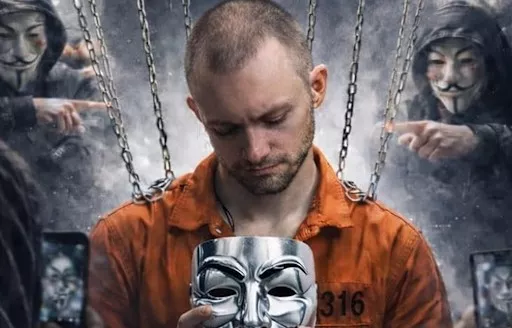
Twenty-five years old, a piece of malware to remotely control dozens of machines, and a botnet as a final act of desperation to take justice into his own hands. Then, darkness: 11 years in federal prison, where time, without a connection, never passes if you are a child of the web and digital culture.
Jesse William McGraw, known by his online alias GhostExodus, was the first person in U.S. history to be convicted of hacking Industrial Control Systems (ICS) and thus to receive a federal sentence in 2009. Since then, the ‘bit by bit’ work he has done on himself has enabled his transition from a ‘threat actor’ to a real person, from a ‘ghost’ to a man, who today, as a security and threat intelligence (OSINT) expert, puts his incredible experience at the service not only of the law, but of ethics.
Today, he runs a grassroots online child safety group and hunts some of the internet’s worst offenders under the banner of his flagship initiative, CYBERVS DOMINATVS. Furthermore, he is an educator and has given several speeches at hacker conferences such as THOTCON, CypherCon, BSides in Vilnius, and HIP Conference 2026. His story is featured in an exclusive Cybernews documentary and in the upcoming cyberwar documentary Midnight in the War Room, which is scheduled to premiere this year at the Black Hat USA 2026.

In his 20s, Jesse worked as a security guard operating as an insider threat by day and hacker by night. Under the alias GhostExodus he was the leader of a hacktivist group known as the Electronik Tribulation Army and also as a member of Anonymous. However, his double life ended the moment he was confronted by the consequences of his hacking operations and was forced to see his reflection in the proverbial mirror.
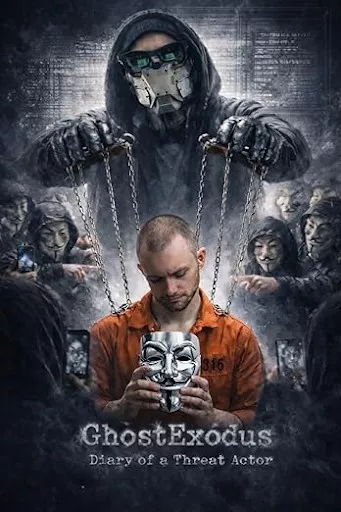
‘GhostExodus: Diary of a Threat Actor’ is his autobiography, serving as a brutal chronicle of the hacker subculture of the mid-2000s, highlighting faction wars and the moral battle that brought him to where he is today. It is also an important record of the underground world, institutional power, surveillance, digital manipulation, the grim reality of isolation, and the moral dilemmas that pushed him over the edge. It is a story to be read and reread, one that teaches us that true strength is not about “wearing a mask,” but having the courage to take it off and build something real.
His book illustrateshow hackers rarely take a moment for introspection or count the cost before it’s too late. Ultimately, his chronicle reminds us that the true spirit of hacking is not to destroy, but to understand how a system works in order to improve it. His experiences have shaped his advocacy within the hacker community, where he emphasizes ethics and reality checks to help limit the scope of cyberattacks against critical infrastructure, such as power stations, hospitals, and schools.
Additionally, the book also serves as a dire warning. In a recent documentary, How Hacking Ruined My Life: Ghost Exodus Story, produced by Silva Rindzevi, Jesse stated, “Prison is not made for hackers, we are not like other people”. Above all, we have much more to give than just sitting in front of a computer screen all our lives”.
“Furthermore, to say that the majority of correctional officers do not see inmates as human beings is an understatement. They treat people worse than animals and resort to creative machinations of psychological warfare, which the everyday inmate is expected to absorb without any reaction.
This is why we compartmentalize ourselves so deeply. In doing so, we ultimately become prisoners of our own minds, fighting ourselves and everyone around us just to survive a continuous environment of high-intensity mental combat.”_GhostExodus: Diary of a Threat Actor, (pg. 486)
During his incarceration, Jesse underwent profound changes that altered how he viewed his past actions. After surviving 13 months in solitary confinement, where temperatures reached 125°F (51.7°C), his perspective was fundamentally reshaped.
Enduring one of the hottest summers in Texas on record at the time, he shifted from reminiscing about his “Devil’s Night” operations and being a no-limits hacker to confronting his own daemons, beginning to see the world, and himself, differently.
Only at the brink of death did the transformation fully take hold, stripping away his need to hide behind a constructed persona, a rogue process running inside a system and revealing a man in search of the “soul beyond the mask” he wore. This realization carries profound meaning for someone who spent most of his life hidden behind usernames, proxies, and layers of anonymity.
GhostExodus: Diary of a Threat Actor is indeed the act of someone who has nothing left to hide after paying his debt to the justice system, but it is also a transparent demonstration of how skills forged in illegality can be converted into an invaluable asset for the protection of society.
While the book reads as part autobiography, part manifesto, it serves as a fascinating and complex journey of redemption and transformation in modern hacker culture. From a digital shadow capable of infiltrating anywhere and a pioneer of ICS convictions, a journey emerges that speaks not only of consequences, but of rare, genuine change, and more importantly, why.
As readers progress through his life story, presented chronologically, they encounter a series of crossroads: the very drive to survive during times of uncertainty and stress can forge an armor that eventually becomes a prison.
“GhostExodus wasn’t protecting power, or my blazing rebellion, or my pride. He was protecting the original, unfiltered core of me. The vulnerable, human, wounded part of me that believed it couldn’t survive anywhere without armor, that didn’t know how to withstand the world as it was. … GhostExodus was my armor, but armor becomes a coffin when you never take it off.”_GhostExodus: Diary of a Threat Actor (pg.625)
In the world of hacking, it is often said that the greatest vulnerability is not a software bug, but human error, or something hiding in plain sight that no one questions. And as David Foster Wallace wrote, “The most obvious, important realities are often the ones that are hardest to see and talk about”, in much the same way, for Jesse, the most obvious reality that eluded him for years was himself:
Ultimately, Jesse transformed his trauma into an act of moral superiority over his own captors, asserting that true power belongs not to those who inflict pain, but to those who have the strength to survive it without being corrupted. The physical and psychological pain imposed from the outside can never break the willpower of those who have chosen never to surrender.
“As if that were the right pressure to get me to start singing the song of despair in a hell of their own design. I am GhostExodus, I do not break. The testimony of human endurance is stronger and more resilient than the well-oiled machines of hatred fashioned by evil meatbags who have made their beds in hell, whose names will be blotted from memory”. _GhostExodus: Diary of a Threat Actor.
When our minds wander between the MIT labs of the 1950s and the modern underground, we realize that this world is far deeper than it seems: it is not merely a matter of technical skill, but of a philosophy that literally built the digital world we live in.
In the underground, it doesn’t matter who you are or what degree you hold, but rather what you can do: solving a complex problem with a single line of code instead of a hundred is the ultimate badge of honor, and vulnerabilities are discovered and patched through constant scrutiny. Make no mistake, the underground is not made up solely of threats, but of continuous improvement, innovation, and a culture of sharing.
Techniques originally developed for tracking within the underground are used today by experts (like Jesse McGraw) for ethical purposes, such as locating missing persons or combating organized crime.
That is where hackers live, the ones who ‘break down’ systems to find their limits, and without them, cybersecurity would still be stuck in the last century. Within the underground lives the very idea that any system, whether human or technological, can be taken apart and understood, driven by the conviction that everything can be rebuilt better than before.
However, as Jesse reminds us, there are dangerous aspects, such as the arrogance of the network: many attackers today seek only fame and ‘bragging rights,’ confusing the power of a malware program with personal greatness.
The underground is also home to stories of outlaws of the electronic frontier, of counterculture, of identities and roles, of crumbling barriers, and of power through technology. Among them is GhostExodus, who first had to lose everything to finally see what was obvious: that his talent was not meant to destroy, but to understand and protect.
“People never think of asking me why I became a botnet operator. I initially explored using bots as an offensive tool because I wanted to help a friend pursue justice against Germany’s foster care system. Maybe it would give him a morsel of peace after his brother’s suicide. I didn’t know how it would help, but he believed it could, so I helped him build botnets so he could seek retribution.”_ GhostExodus: Diary of a Threat Actor.
But if we agree with the fact that “actual heroism receives no ovation, entertains no one. No one queues up to see it. No one is interested”, then we will agree with David Foster Wallace that “it takes great personal courage to let yourself appear weak”.
Personally, I have several things to say about him, and many of them are not traits you find in just anyone: he is capable of sharing, because technical knowledge of the tools must not remain a privilege for the few, and not everyone is capable of that.
Jesse is a person who wants to change the world for the better and actually does it, and not everyone is capable of that. Finally, he is an extremely intelligent man. And not everyone is. These qualities, along with the awareness that ‘together we are stronger,’ make Jesse a rare individual who has managed to transform his scars into a vision for the future. It is precisely this that carves an unbridgeable divide between Jesse McGraw and the mass of ‘alleged hackers’ or mere cyber attackers.
You can find his book, GhostExodus: Diary of a Threat Actor, on Amazon.”