



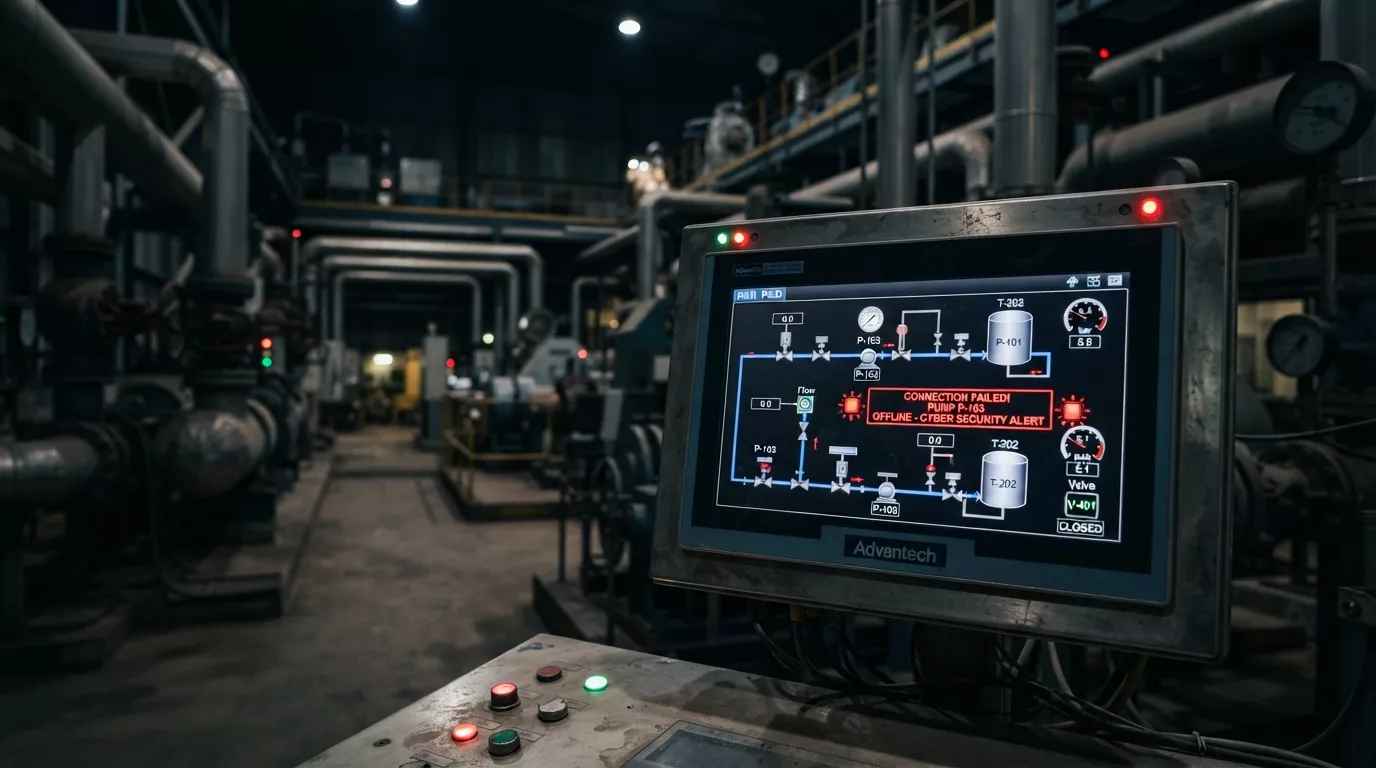
The intrusions observed in 2026 against OT/ICS environments and their supporting IT systems are driven predominantly by three vulnerability factors: Internet exposure, lack of authentication, and deterministic automation. In other words, OT/ICS environments and their supporting IT systems continue to be compromised through elementary misconfigurations and already-patched CVEs. And while agentic AI accelerates vulnerability research in controlled settings and scales reconnaissance against known weaknesses, the dominant vectors remain misconfiguration and the absence of authentication.
On the OT/ICS front, a low-cost and highly “commoditized” toolkit — TRK25 ADVANCED SCADA — has evolved from a simple VNC/Modbus scanner into a multi-protocol framework, whose armed ADVANCED build began circulating more widely starting in June 2026 [EXTERNAL]. Sold for profit by the Infrastructure Destruction Squad (BLACKNET-00), this tool drastically lowers the barrier to entry for mapping and reaching industrial assets exposed on the Internet. Separately, pro-Russian and allied hacktivist groups — including NoName057(16), Z-Pentest Alliance, CARR, AlfaNet, Sector16, and more recent aliases such as Disrupt0r and Cl0wnZ — have claimed a wave of OT/ICS intrusions in Europe and beyond [CLAIM] / [EXTERNAL]. This report rigorously keeps vendor and user separate: we do not attribute the kit’s authorship to any ideological banner, and we advance as a working hypothesis ([ANALYST HYPOTHESIS]) that these groups use TRK25 or tools belonging to exactly the same family.

Two technical samples analyzed in this report — fuxapwn (which targets the open-source FUXA HMI via CVE-2026-25895) and wp2shell (which targets WordPress via SQL injection) — confirm the same pattern: static, human-written scripts that exploit exposed, unauthenticated systems with excessive privileges, with no use of machine learning. Meanwhile, the emerging agentic pentesting frameworks — ARTEX (used by Storm-0940 in the ConnectWise campaign) and CAIRN (used by CL-STA-1238 against the semiconductor and defense sectors) — replicate this same economics-driven “commoditization” one level up the stack: they industrialize the coverage of already-known weaknesses at machine speed, rather than discovering novel zero-days [EXTERNAL]. On both fronts, the decisive defensive lever remains upstream: eliminate exposure on the public Internet, remove default credentials, and patch known flaws.
A low-cost, commoditized toolkit meeting a broad OT surface exposed on the Internet puts basic industrial disruption capability within reach of non-state and low-skilled actors. Ideology drives the target list, while economics drives the tooling. Because the distribution of the armed TRK25 build is recent (mid-2026) and its industrial ransomware module has not yet been confirmed in active field campaigns, the window for preventive hardening is open now — and the same basic hygiene controls (removing OT from the public Internet, enforcing authentication, and patching known CVEs) simultaneously neutralize both low-cost scanners and AI-accelerated pentesting frameworks.
For non-technical readers and management, this box illustrates the central mechanism of the report using one of our technical samples (fuxapwn, analyzed in detail in the case studies).
What FUXA is: FUXA is free, open-source software used to create control dashboards through which operators monitor and manage a plant — pumps, valves, temperatures, levels. It is the screen that shows the plant’s status and allows commands to be sent.
What the attack script does, step by step:
Why it “leaves the door open” (persistence): normally, an operator might think that restarting or updating the server removes the intruder. Here it does not: the hidden access is designed to survive restarts. Truly closing it requires full remediation: removing both the scheduled task and the backdoor in the configuration, taking the panel off the public Internet, enforcing authentication, updating the software, and changing the default cryptographic key.
Why it matters: a control dashboard can be the entry point to the physical process. If the commands displayed on screen are actually linked to PLCs and actuators, an intruder can, in principle, alter operating settings — for example, stopping pumps, opening or closing valves, or changing temperature setpoints. However, access to the dashboard does not automatically equate to control of the process: it depends on how tags are mapped to the automation system.
Why it is not AI: there is nothing “intelligent” or adaptive in this sequence. It is a fixed, hand-written script that succeeds solely because the panel was exposed online, without a password, and with excessive privileges: a simple computer executing rigid instructions, not an AI reasoning in real time.
Honest caveat: the specific target claimed in the sample analyzed in the fuxapwn case study shows clear indicators of a honeypot set up by researchers. It should be read as a demonstration of how the technique works, not as proof that a real plant was breached.
[CLAIM] — Unverified claim made by the actor · [EXTERNAL] — Public reporting from vendors or OSINT sources · [ANALYST HYPOTHESIS] — Working hypothesis proposed for multi-source corroboration, not a definitive confirmation · [UNVERIFIED] — Reported element, not independently confirmed in this analysis · [ANALYST ASSESSMENT] — The author’s analytical judgment, clearly distinguished from reported facts · [OBSERVED] — Directly observed in the analysis of the script or the provided execution output, not independently executed. Confidence is classified on a High / Medium / Low scale (ICD 203 standard).
IN BRIEF
Scope note. This report covers OT/ICS and related attacks throughout 2026, but is deliberately non-exhaustive, and the timeline that follows is a simplified selection — some dates are omitted for clarity rather than cataloging every single incident. The aim is to clarify the problem, the underlying vulnerability (systems exposed on the Internet, lacking authentication, with excessive privileges), and some of the tools used. Similar activity also predates this time window: for example, as early as September 2025, pro-Russian and allied groups had claimed access to exposed HMI/SCADA systems in Europe, including claims by TwoNet/DarkWarios against a controller of a heating plant and a chiller/refrigeration system in Poland (22–23 September 2025) [CLAIM].
| Date (2026) | Track | Event | Source / Tag |
| Feb (7 Feb) | OT / TRK25 | TRK25 ADVANCED SCADA advertised (~USD 500); full source code allegedly leaked/shared on Telegram and PWN Forums (timing contested vs. June build). | [EXTERNAL: Forescout; FemtoSec] |
| 9 Feb | Specimens & OT | CVE-2026-25895 in FUXA (critical, unauthenticated arbitrary file write) disclosed and patched in v1.2.10. | [EXTERNAL: NVD / GHSA] |
| 23 Feb – 20 Mar | OT / TRK25 | Early TRK25 / BLACKNET-00 traces: groundwater-pump video claim (23 Feb), Turkish VNC screenshot (9 Mar), BLACKNET-00 Python sample on VirusTotal (10 Mar), 32/50 test-list IPs observed online (20 Mar). | [EXTERNAL: Forescout] |
| Mar | OT / Claims | Precursor Internet-exposure and actor-intent signals observable ahead of the late-2026 OT wave (early-warning tracking). | [ANALYST ASSESSMENT] |
| 7 Apr | OT Baseline | CISA AA26-097A published on Iranian-affiliated APT (CyberAv3ngers / Shahid Kaveh) compromising Internet-exposed PLCs in US water and energy sectors. | [EXTERNAL: CISA] |
| Apr – May | OT / TRK25 | Initial Forescout Vedere Labs (28 Apr) and Undercode Testing (~May) reporting on ~3.4M exposed RDP/VNC servers and TRK25 “commoditised kill switch” framing. | [EXTERNAL: Forescout; Undercode] |
| 1 Jun – Jun | OT / TRK25 | VECERT (@VECERTRadar) critical alert (1 Jun); June push noted with ADVANCED build enhancements, dedicated ICS channel (USD 200), and public builder release. | [EXTERNAL: VECERT; KELA; Ransom-ISAC] |
| Jul (3 Jul) | OT / TRK25 | FemtoSec actor profile published (3 Jul); 313 Team claims TRK25 use ([CLAIM]). | [EXTERNAL: FemtoSec; Ransom-ISAC] / [CLAIM] |
| Jul | Agentic AI | ARTEX open-source AI pentesting platform released on GitHub (Autumn-27). | [EXTERNAL: FBI FLASH] |
| 26–27 Jul | OT Baseline | Coordinated intrusion hits 30+ Minnesota community water systems via Internet-exposed PLCs (catalogued in MITRE ATT&CK v20 as unattributed Campaign C0066). | [EXTERNAL: MNIT; MITRE ATT&CK] |
| Aug (19 Aug) | OT / TRK25 | Ransom-ISAC profiles Infrastructure Destruction Squad / BLACKNET-00 as a for-profit toolkit vendor and loose access broker. | [EXTERNAL: Ransom-ISAC] |
| Aug – Sep | Agentic AI | China-nexus actor CL-STA-1238 conducts 25 operations against 19+ organisations using CAIRN. | [EXTERNAL: Palo Alto Unit 42] |
| Sep (3 Sep) | OT / TRK25 | KELA reports TRK25 deployment targeting France, Turkey, Germany, South Korea, Taiwan, and Australia. | [EXTERNAL: KELA] |
| Sep | Agentic AI | Storm-0940 begins operational use of ARTEX. | [EXTERNAL: Microsoft] |
| Oct – 5 Nov | Agentic AI | Storm-0940 compromises ConnectWise Cloud Backup using ARTEX (10–14 Oct spray); parallel ARTEX campaign steals exposed AI API keys (3 Oct – disrupted 5 Nov); adjacent Fireworks / Cursor key theft (late Oct). | [EXTERNAL: Microsoft; Amazon; Fireworks] |
| Aug – 19 Nov | OT / Claims & Specimens | Surge of hacktivist OT/ICS access claims across Europe and globally (NoName057(16), Z-Pentest, wiped404 19 Nov battery-bank claim); Disrupt0r/Cl0wnZ circulate fuxapwn FUXA RCE script (Nov); Siemens CVE-2026-58115 reported under active exploitation. | [CLAIM] / [UNVERIFIED] |
| Nov (12 Nov+) | Agentic AI / OT | Unit 42 (CL-STA-1238 / CAIRN, 12 Nov), FBI FLASH (ARTEX, 13 Nov), GTIG (16 Nov), and Trellix OT Threat Report published. | [EXTERNAL] |
External sources diverge on when TRK25 ADVANCED SCADA was first weaponised and commercialised. Forescout and FemtoSec date the public source leak of the ADVANCED build to 7 February 2026 (with a ~USD 500 Telegram/forum listing in February), whereas KELA and Ransom-ISAC highlight a June 2026 operational push — comprising the VECERT alert (1 June), a dedicated USD 200 ICS channel, and the public builder release — followed by broader reported country deployments around September 2026. The exact onset of commercial distribution remains [UNVERIFIED].
The dominant narrative around OT/ICS security in 2026 holds that autonomous, agentic AI is actively attacking critical infrastructure — automating reconnaissance, adapting exploits in real time, and collapsing the interval between vulnerability disclosure and exploitation. Three underlying trends are genuine and worth stating plainly so this analysis reads as precision rather than denial:
However, two structural distinctions prevent this narrative from being mistaken for how infrastructure is actually being compromised in the wild:
The most useful analytical anchor comes from the BSI report itself: “whoever is an easy target gets attacked,” naming small and mid-sized businesses and municipalities as the hardest-hit victims, with fewer than half applying basic security measures. Victims are selected by exposure and absent hygiene, not attacker sophistication. Collapsing time-to-exploit matters precisely because so many targets remain soft — the window closes before the door is shut.
Where this report’s specimens sit. Our two technical case studies (detailed later) — fuxapwn, turning an exposed FUXA HMI into persistent root RCE via cron, and wp2shell, turning a WordPress SQL injection into a web shell — belong squarely to wild / exploitation / exposure, not lab / discovery / AI. Neither requires a model; both require an exposed, unauthenticated, over-privileged host. AI raises the ceiling (in labs and vulnerability research), while the floor — where real-world attacks live — is opened by misconfiguration. Defences investing in “AI detection” while leaving an HMI exposed as root on the public Internet have optimised the wrong variable.
A typical OT/SCADA intrusion progresses across seven stages:
1. Reconnaissance (exposed services, vendors, HMIs, protocols) → 2. Initial access (exposed apps/VPNs, stolen creds, supply chain) → 3. Persistence (accounts, scheduled tasks, backdoors) → 4. Privilege escalation (admin/root, jump hosts, SCADA servers) → 5. Lateral movement (IT → DMZ → OT) → 6. OT discovery (tags, logic, stations, pumps, valves) → 7. Manipulation / impact (commands, setpoints, process stops, safety disruption). MITRE ATT&CK for ICS organises this lifecycle across 12 tactics.
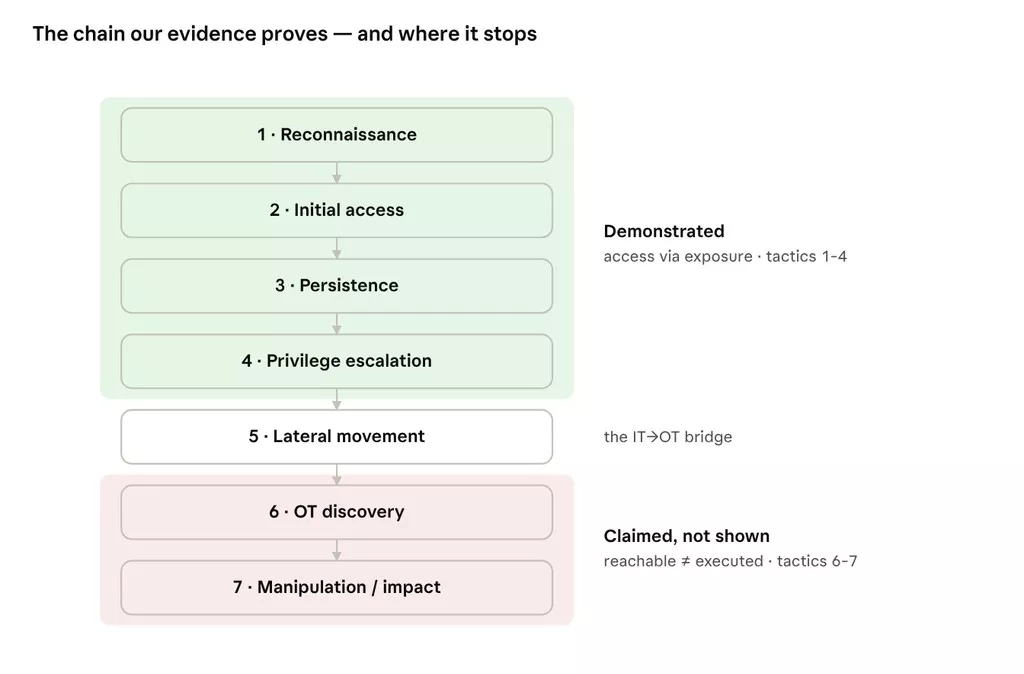
OT kill-chain · our evidence proves tactics 1–4; tactics 6–7 are claimed, not shown
The three specimens examined:
| Specimen | Lifecycle Stage | ATT&CK for ICS (Indicative) |
|---|---|---|
| TRK25 (scanner) | 1 Recon · partial 6 OT discovery | T0846 Remote System Discovery · T0888 Remote System Information Discovery · T0802 Automated Collection (screenshots) |
| wp2shell (IT/web) | 2 Initial access · brief 3 persistence · collection | T0819 Exploit Public-Facing Application · T1701.005 Python / T1701.003 Unix Shell· T0859 Valid Accounts (minted admin) |
| fuxapwn (FUXA HMI) | 2 Initial access · execution · 3 persistence | T0819 / T0866 (CVE-2026-25895) · T1701.005 Python / T1701.006 JavaScript · T0889 Modify Program (cron / settings.js) |
Claimed vs. demonstrated. All three tools prove capability on tactics 1–4, unlocked by exposure (an unpatched CVE, absent login, or root execution). None of the observed actor drops demonstrates the right side of the chain — Inhibit Response Function, Impair Process Control, or Impact (T1692.001 Unauthorized Message: Command Message (formerly T0855)., T0836 Modify Parameter, T0831 Manipulation of Control, T0881 Service Stop, T0880 Loss of Safety). Attackers may claim they have taken control of the facility, but they often do not show evidence that they actually interfered with the process. Having access to the HMI makes interference possible, but it does not prove that the interference was actually carried out.
Defensive consequence. Since most demonstrated attacks rely on tactics 1–4, removing external Internet access immediately blocks a large part of these attacks.
If an attacker still gets into the network, the last line of defence is physical safety: safety systems that automatically stop dangerous operations, and local controls that do not accept remote commands.
Technique breakdown: exposure vs. targeted tradecraft
Rather than relying on sophisticated intrusion paths, the commodity activity tracked in this report collapses the standard multi-hop enterprise-to-OT chain into a single hop straight to the exposed panel:
APT baseline comparison: CISA AA22-103A (2022)
Comparing these commodity crews against CISA’s 2022 advisory AA22-103A (PIPEDREAM / INCONTROLLER, 13 April 2022) clarifies where capability stops:
| Dimension | APT Baseline (AA22-103A) | Commodity Hacktivist Crews (2026) |
|---|---|---|
| Targets | Specific controllers (Schneider MODICON, OMRON Sysmac, OPC UA servers, engineering workstations) | Any HMI or web panel left exposed and unpatched |
| Access Path | Device-specific, following initial OT network entry | Direct — exposed device with no authentication or a known CVE |
| Protocol Capability | Custom Modbus / CODESYS / FINS / OPC UA; PLC password brute-force; tag read/write | None demonstrated — activity stops at the HMI host |
| PLC & Destruction Capability | Uploads/downloads PLC programs, alters operating mode/firmware, “packet of death” PLC crash, session hijack | Not demonstrated |
| Workstation Exploitation | Windows kernel-driver exploit (CVE-2020-15368) | Not used |
| Right-of-Chain Impact | Implemented (control manipulation, loss of safety/availability, physical risk) | Claimed, not shown ([CLAIM]) |
| Operational Profile | Narrow, targeted, quiet | Broad, automated, cheap, loud (propaganda) |
The verdict: commodity actors fall well short of the AA22-103A baseline in every capability that produces verified physical OT impact. They differ in breadth and noise — mass scanning, rapid weaponisation of public CVEs, and loud public claims. Yet both threats converge on the same foundational defence: do not expose the device.
On 7 April 2026, a joint advisory — CISA AA26-097A, issued by the FBI, CISA, NSA, EPA, DOE, and CNMF — documented Iranian-affiliated APT activity, including actors associated with CyberAv3ngers and the “Shahid Kaveh Group”, attributed by reporting to the IRGC Cyber-Electronic Command [EXTERNAL]. The advisory also referenced parallel reporting linking related activity to a 2026 supermarket-refrigeration campaign [EXTERNAL].Two takeaways anchor our model:
Authoritative 2026 reporting (CISA AA26-097A, Trellix OT Threat Report Nov 2026, Dragos 2026 Year in Review, Dragos Industrial Ransomware Analysis Q3 2026) reinforces the exact same picture — remote access to exposed OT and configuration manipulation, not AI agents [EXTERNAL]:
| Phase | Predominant 2026 TTP | 2026 Example |
|---|---|---|
| Reconnaissance | Scanning exposed PLC/HMI, hunting VNC and remote services | Industrial devices exposed on the public Internet |
| Initial Access | Direct PLC/HMI access, exposed app exploits, compromised VPNs | Exposed Allen-Bradley PLCs; VPN gateways abused by Voltzite |
| Credentials | Weak/default passwords, credential theft, valid accounts | Admin-password changes in Minnesota water systems |
| Lateral Movement | IT → DMZ → engineering workstation → SCADA/HMI/PLC | SCADA config extraction from engineering workstations |
| Persistence | New passwords, config changes, retained remote access | IP and credential changes in water systems |
| Impact | Ladder-logic edits, pump stops, HMI defacement, PLC manipulation | Reported pump logic altered, HMIs blacked out |
| Supply Chain | Vendor, update, or third-party access compromise | PYROXENE and PARISITE activity in the Dragos model |
Positioning our commodity actors: Compared with 2022, the 2026 landscape combines direct Internet reachability of PLCs/HMIs, compromises of remote-access and edge infrastructure, manipulation of engineering and configuration data, and a more specialised access-broker ecosystem. Our commodity crews sit on the cheapest, left-hand rungs: exposed HMI/PLC interfaces combined with weak or default credentials. They do not exhibit access-broker specialisation, Voltzite-level SCADA-configuration theft, or demonstrated control-logic tampering. Yet state-aligned APTs, access brokers, and hacktivists can all exploit the same foundational weakness: unnecessary Internet exposure.
2026 sources: CISA AA26-097A · Trellix OT Threat Report, November 2026 · Dragos 2026 Year in Review · Dragos Industrial Ransomware Analysis, Q3 2026.
FUXA 2026 CVEs: CVE-2026-25895 · CVE-2026-25752 · CVE-2026-25938 · CVE-2026-25951 (NVD; details cross-checked against OSV and INCIBE-CERT).
The verdict: Commodity actors remain concentrated at the exposure-and-credential layer. State-aligned APTs and specialised access brokers demonstrate greater capability to reach, extract, and manipulate engineering and configuration data; commodity crews largely demonstrate access to exposed interfaces and credential misuse. The common failure is not sophistication, but unnecessary exposure.
A low-cost OT/ICS scanning kit is circulating on criminal channels, sold by a for-profit group also active in ransomware and industrial espionage [EXTERNAL]. Ransomware is framed as the follow-on phase after access. The kit is deliberately unsophisticated: it does not require zero-day exploits, instead, it automates the discovery of absent security controls — mapping what is exposed and directly reachable from the public Internet.
What it does. TRK25 ADVANCED SCADA sweeps IP ranges, identifies Internet-facing systems, and classifies them by protocol and operational function — industrial control, automation, telecontrol, remote access, and web management interfaces. According to VECERT, it scores discovered hosts by risk (critical to low) and bundles a database of default credentials for major vendors including Siemens, Rockwell, and Schneider.
| Protocol | Port(s) | Typical Exposure Behind Port |
|---|---|---|
| Modbus TCP | 502 | PLCs, RTUs, I/O modules |
| OPC UA | 4840 | Automation middleware |
| PROFINET | 34962 / 34963 / 34964 | Industrial Ethernet |
| DNP3 | 20000 | SCADA / telecontrol (utilities) |
| Siemens S7comm | 102 | Siemens PLCs |
| BACnet | 47808 | Building automation / HVAC |
(In addition to OT protocols, external reporting confirms TRK25 probes remote-access interfaces — VNC/5900, RDP/3389, and SSH/22 —often reaching assets such as pumps, valves, sensors, inverters, water/irrigation controls, energy assets, and building automation with default or absent credentials.)
Lineage and weaponisation. Designated TRK25 ADVANCED SCADA by VECERT, the tool evolved from Kurtlar_SCADA.exe — an earlier VNC/Modbus scanner previously used by actors previously associated with ICS-targeting activity in geopolitical contexts [EXTERNAL]. The ADVANCED iteration adds multi-vector DDoS, unauthenticated screenshot capture and exfiltration, the vendor default-credential database, and an advertised, partially observed industrial-ransomware module. VECERT (@VECERTRadar) flagged active development on 1 June 2026; five months later, the toolset is operational. The core defensive rule is straightforward — not “no remote control,” but “no remote control without authenticated, authorised, and monitored access” (consolidated hardening controls are detailed in the Defensive Guidance section).
Source Alert — VECERT, 1 June 2026: TRK25 ADVANCED SCADA [EXTERNAL]Summarised from the VECERT (@VECERTRadar) intelligence alert that first publicly flagged the build: Cyber Intelligence Alert — Malicious tool for critical infrastructure (TRK25 ADVANCED). Status: critical. A malicious tool, TRK25 ADVANCED SCADA, is being distributed for the exploitation, reconnaissance, and exfiltration of data from industrial control systems (ICS) and utilities. It is a Python-based GUI that enumerates and attacks exposed systems.Stated capabilities:
- Industrial reconnaissance: scanning to detect PLC, SCADA, and HMI devices across entire networks.
- Protocol exploitation: MODBUS device compromise, Siemens S7/PROFINET exploitation, and DNP3 attacks.
- Access and interface: detection of hidden control panels, brute-forcing of graphical-interface passwords, SSH access, VNC-server exploitation.
- Denial of service: six attack modes (SYN, UDP, TCP, HTTP, Slowloris, ICMP) with configurable duration and thread count.
- Exfiltration and espionage: unauthenticated screen capture (VNC, RDP, HTTP); encrypted exfiltration over DNS, HTTP, or ICMP; storage in a local SQLite database.
- Management: risk classification (critical to low); default-credential database for Siemens, Rockwell, and Schneider.
- Origin: evolution of prior tooling, including Kurtlar_SCADA.exe, formerly used by groups linked to geopolitical conflicts to attack ICS.
- Future risk: developers announced an upcoming ransomware creation/deployment module for industrial infrastructure.
(Note: Tool name and Kurtlar_SCADA.exe serve as indicators; no operational exploit code is reproduced.)
Five independent vendor and ISAC analyses — ordered chronologically — corroborate TRK25’s exposure-driven mechanics and commercial vendor model [EXTERNAL]:
Synthesis. Direct observation of the distribution channel and the tool’s advertised capabilities, combined with external reporting, supports a two-layer reading. Infrastructure Destruction Squad / BLACKNET-00 operates as the for-profit toolkit and ransomware vendor (TRK25 plus the BLACKNET-00 builder), while OT-intrusion claims emerge from hacktivist operators — including Z-Pentest, which circulated the TRK25 source, as well as CARR, AlfaNet, and newer actors reportedly solicited or offered the tool, including 313 Team and HEXVIOR. While KELA and FemtoSec report or assess activity involving these crews, Ransom-ISAC treats the code-lineage link as a working analytic hypothesis — the same standard applied below when separating vendor from user.
Analytic flag — do not conflate: Ransom-ISAC’s “313 Team” and the “Cyber Squad 313 PK” observed in #OpGermany should be treated as potentially distinct entities unless independent evidence establishes that they are the same actor or cluster. Their equivalence is unverified [UNVERIFIED].
The table below inventories actors with claimed OT/ICS intrusions tracked from March through 19 November 2026. To avoid amplifying unverified victim naming, targets are listed by sector and country rather than organisation name. Consistent with the source-tag legend above, [CLAIM] denotes unverified actor statements or screenshots, while [EXTERNAL] denotes contextualisation or partial corroboration by public vendor, ISAC, or advisory reporting. An [EXTERNAL] tag does not, by itself, confirm the full claimed intrusion or its operational impact.
| Actor | OT/ICS Targets (Sector / Country) | Claimed Action | Confidence (OT Attribution) | Source Tag |
|---|---|---|---|---|
| NoName057(16) | Industrial autoclaves, fertigation, hydroelectric (IT); industrial drying, gas-piston power plant (DE); mass CCTV (DE) | HMI/SCADA access; parameter/control manipulation; “switched to manual” | Moderate | [CLAIM] |
| Z-Pentest Alliance | Reverse-osmosis water, energy, CCTV; Rapid SCADA energy/gas (BG, with AlfaNet) | HMI/SCADA access via exposed devices | Moderate–High | [CLAIM] / [EXTERNAL] |
| CARR (Cyber Army of Russia Reborn) | Water treatment (PL), power plant (FR) | ICS access claims; EU/US sanctioned | High (externally profiled; GRU-linked per KELA) | [EXTERNAL] |
| Sector16 | Hydroelectric (affiliations with OverFlame) | ICS access | Moderate | [EXTERNAL] |
| OverFlame | Hydroelectric (FR) | Valve manipulation claimed | Low–Moderate | [EXTERNAL] |
| TwoNet | SCADA access offered for sale; hydroelectric (FR) | SCADA access | Low–Moderate | [EXTERNAL] |
| DarkWarios | Biomass boiler (CZ), HVAC/CCTV, smart-home panel | SCADA/HVAC access | Low–Moderate | [EXTERNAL] |
| CyberTroops | Solar control panels (DE, IT) | Panel access | Low–Moderate | [EXTERNAL] |
| AlfaNet | Rapid SCADA energy/gas (BG) | Default-credential access | Moderate | [EXTERNAL] |
| “HIDROTEC” vector (via NoName057(16) / Z-Pentest) | Reverse-osmosis water (ES) | HMI switched to manual; low-pressure alarm | Low–Moderate | [CLAIM] |
| Refrigeration wave | Retail cold chain, food (multi-country) | Refrigeration control disruption (see French attribution of Shahid Kaveh) | Low (contested attribution) | [CLAIM] |
| wiped404 | Energy / battery storage (EMS/BMS); precision manufacturing (CH) | Claimed full control and “Hauptschalter” kill switch of a 223 MWh industrial battery bank (19 Nov 2026) | Moderate | [CLAIM] |
| Disrupt0r | Internet-exposed HMI/SCADA; water-treatment HMI (FUXA); OT gateways | “Intel drops” on unauthenticated HMI/SCADA (UK water HMI, IN SCADA); Nov 2026: root RCE on a FUXA water-plant HMI via cron write (target shows honeypot/demo markers) | Moderate–High (technique); Low (target reality) | [CLAIM] |
| Cl0wnZ | SCADA/HMI — industrial coating (PVD, DE); water (FUXA, via Disrupt0r) | Claimed SCADA/HMI exploitation of a German PVD coating plant; author/source of the FUXA cron-RCE script; unverified GRU + clown self-branding | Moderate | [CLAIM] |
Cross-actor behavioural signal. Worth flagging as an operational signal, not as attribution: multiple claims reference the same hostname noname05716 left on compromised HMIs and the recurring phrase “control switched to manual.” Across the table, the persistent entry vector is default or absent authentication on Internet-facing HMI/SCADA interfaces — a surface consistent with the broader exposure-driven tooling pattern that includes TRK25.
Reported Active Exploitation — Siemens SIMATIC IoT2050 / Node-RED (November 2026) [EXTERNAL / UNVERIFIED — Low confidence; no independent confirmation]
CVE-2026-58115 (CVSS 10.0, missing authentication leading to RCE) in Siemens industrial gateways has been reported as under active exploitation, with reported attacker activity involving unauthenticated HTTP requests to deploy Linux-based bot malware on devices running Node-RED. Siemens had previously issued configuration guidance. Pending independent confirmation, the reported vector is consistent with the broader exposure-driven tooling pattern that includes TRK25: an Internet-exposed OT gateway with absent authentication, requiring no advanced exploitation capability.
No evidence currently links this activity to TRK25 specifically. The observed pattern may reflect TRK25, a similar commodity tool, or independently developed scripts exploiting the same underlying exposure.
Live November 2026 ecosystem sample (non-exhaustive). Throughout November 2026, actors across this ecosystem — including the Cl0wnZ / Cl0wnZSec / Disrupt0r cluster (whether these represent aliases, sub-groups, or allied accounts remains unresolved), Z-Pentest Alliance, NoName057(16), Sector16, and TwoNet — maintained a steady stream of access claims against exposed, unauthenticated HMIs using low-cost, reusable scripts. Affected sectors spanned energy and heating (biomass boilers, home/building energy management), water treatment, food processing (grain milling), healthcare, industrial refrigeration/cold chain, and HVAC/building management. Broad panel exposure is visible across European states as well as Ukraine, the United States, India, and beyond. Because screenshots demonstrate only panel visibility — not physical impact or a persistent foothold — and because mapping unverified claims to specific victim sites is unreliable and potentially harmful, exposure by sector and geography, rather than a target list, is the primary finding.
Evaluating higher-stakes narratives (PanelView example). Some claims go beyond raw screenshots. A November claim targeting a wastewater lift station’s Allen-Bradley PanelView HMI asserted full facility control, a foothold inside a flat /24 OT network, and being “one command away” from forcing both pumps off to trigger a wet-well overflow and regulatory fines. Read with analytical discipline, the posted evidence establishes only visibility of the PanelView interface; write authority and network traversal are asserted, not shown. “One command away” means — by its own phrasing — not executed. A richer technical narrative raises the stakes of a claim, not the strength of its evidence.
Although November 2026 saw a dense burst of claims, the underlying conditions were readable long before exploited CVEs and Internet-facing control panels predate these hacktivist posts by years, not weeks.
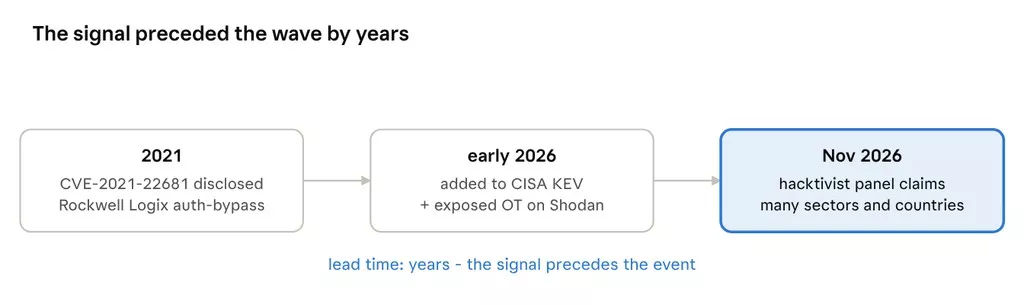
By March 2026, precursor indicators for this surge were already measurable in public telemetry.I verified this retrospectively using a machine-learning early-warning approach that weighted public exposure counts across industrial ports, CISA KEV exploited-in-the-wild status, and observed actor intent. The result indicates that the exposure surface was observable months ahead of the November wave, rather than merely describable after the fact.
The actors inventoried above operate under ideological banners; the scanning kit profiled earlier (TRK25) does not. Keeping these two layers separate is central to this analysis: the kit is sold commercially, while the ideological framing may serve as cover. Attributing the software’s authorship to an ideological crew without forensic evidence would be speculative. The tooling layer can be mapped without attributing ultimate authorship.
| Software / Artefact | Function | Operational Link to OT Activity | Source Tag |
|---|---|---|---|
| TRK25 ADVANCED SCADA | Discovery and risk-rating of exposed ICS; default-credential DB (Siemens/Rockwell/Schneider); DDoS, exfiltration, announced ransomware module | Commodity access layer; lowers entry barrier regardless of actor flag | [EXTERNAL: VECERT] |
| Kurtlar_SCADA.exe | Predecessor of TRK25; ICS attack tooling | Previously used by groups tied to geopolitical conflicts | [EXTERNAL] |
| S7Flip | OT malware (watchlist) | Referenced in tracking reporting; operational linkage remains uncorroborated | [UNVERIFIED] |
| Default-credential databases | Pre-loaded vendor credentials for major ICS platforms | Can convert exposure into access where default or known credentials are present. | [EXTERNAL] |
The analytical stance. Ideology may explain target selection; economics explains the tooling layer. A for-profit vendor builds and sells the capability, while hacktivist crews provide the motive and the #Op framing. An exposed HMI can be discovered using a commercial scanning kit and subsequently claimed under a geopolitical hashtag, without the developer and the poster necessarily being the same entity. Therefore, public claims should be attributed to the channels that posted them; kit authorship should not be attributed to an ideological flag.
Working hypothesis: operational overlap, not authorship. [ANALYST HYPOTHESIS]
This report advances an operational-correlation hypothesis: the OT-intrusion claims in the actor inventory show substantial overlap with the type of access enabled by commodity OT tooling, including TRK25 ADVANCED SCADA and functionally comparable capabilities. This is not a forensic finding, nor does it establish that a specific crew used TRK25. It concerns possible tool usage, not tool authorship.
TRK25 ADVANCED SCADA is presented as a commercially available OT-focused capability set. Its advertised functions include discovery and risk-rating of Internet-exposed industrial systems; a default-credential database covering major ICS vendors, including Siemens, Rockwell, and Schneider; DDoS functionality; exfiltration functionality; and an announced ransomware module. These capabilities are relevant because they can lower the entry barrier to exposed ICS: an actor does not need bespoke exploit development to identify exposed panels, test weak or default credentials, or conduct disruptive network activity.
The inventory nonetheless suggests heterogeneous tooling. Some crews appear to employ bespoke or personally maintained capabilities, while others may rely on commodity kits, shared scanning infrastructure, or publicly available utilities. This heterogeneity is consistent with a layered ecosystem in which commercial scanning platforms, custom tooling, and opportunistic access coexist. TRK25 should therefore be assessed as one possible component of the access layer, rather than as a single explanatory framework.
The relevant question is not whether a crew used TRK25 specifically, but whether its claimed activity is consistent with a commodity access pathway: exposed HMI or SCADA interface, weak or default credentials, protocol-level access, and public evidence of visibility rather than demonstrated process manipulation. Identical capabilities, a similar victim profile, and the same low barrier can explain how a commercial toolkit and an ideological claim converge on the same exposed HMI without implying shared authorship or operational linkage.
Public claims should be attributed to the channels that posted them. Tool authorship should not be attributed to an ideological flag, and the presence of a capability should not be conflated with demonstrated use. Sanitised technical indicators and TRK25-related IOCs are consolidated in the Indicators of Compromise section.
Escalation ladder: severity ranking of the three specimens
Viewed together, the three specimens analysed in this report form a clear escalation ladder: reconnaissance identifies the open door, while the two exploitation scripts traverse it to different depths. Every rung turns on the same root cause: exposure and misconfiguration, not AI. Ordered from reconnaissance at the bottom to OT host compromise at the top:
| Tool | Tier | What It Achieves | Access | Persistence | Severity |
|---|---|---|---|---|---|
| TRK25 (ADVANCED SCADA / VNC) | Recon | Scans and fingerprints exposed PLC/SCADA/HMI and VNC; default-credential brute force; screenshots | Read / enumerate (no execution) | n/a | Low impact / high reach |
| wp2shell | IT / Web | SQLi → admin minting → web shell; theft of secrets (DB password, GPG keys, Kubernetes env) | Host via web shell | No (self-cleans) | Medium |
| fuxapwn (FUXA) | OT | root RCE on a SCADA/HMI host; reach to the controlled process (setpoints, PLCs) | root | Yes (cron + web shell) | High |
Severity tracks two axes: access obtained and potential proximity to the physical process. TRK25 maps exposure; wp2shell compromises an IT host and its secrets; fuxapwn compromises the OT host and may enable reach toward the controlled process. Closing public exposure removes the initial access pathway for the entire ladder.
Case Study 1 (OT): fuxapwn — FUXA Cron-Write / Web-Shell RCE
A mid-November 2026 “intel drop” circulated by Disrupt0r (sourced from Cl0wnZ / ./Cl0wnZSec_ and reposted by a channel branded GRU_Skylor) provides a textbook counter-example to the narrative of autonomous, AI-accelerated exploitation. The specimen contains neither novel discovery nor adaptive reasoning.
What the script does. The tool executes three deterministic stages against an Internet-exposed FUXA HMI, an open-source Node.js SCADA/HMI package:
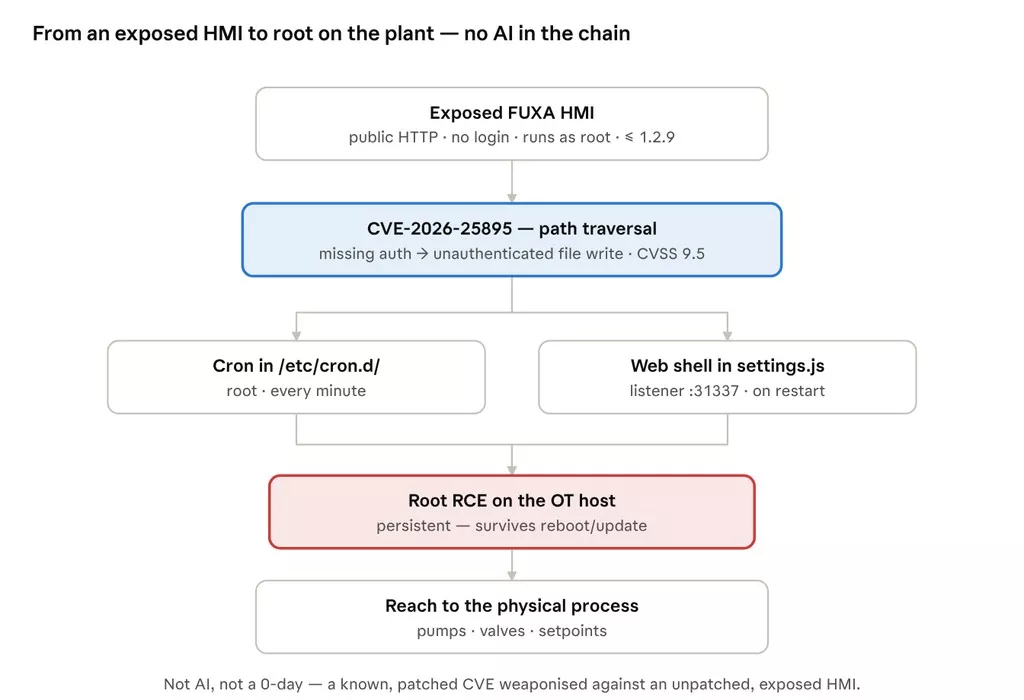
FUXA attack chain: exposed HMI → CVE-2026-25895 → cron / web shell → root
The vulnerability and the 2026 FUXA CVE cluster. The arbitrary file write in stages 1–2 corresponds to CVE-2026-25895, a path traversal with missing authentication (CWE-22 / CWE-306) affecting FUXA ≤ 1.2.9. It is rated critical (CVSS 9.5 per DevGuard; other sources differ) and was disclosed in February 2026 (fixed in v1.2.10; GHSA-88qh-cphv-996c) [EXTERNAL]. This is neither a zero-day nor an AI discovery. It is a roughly nine-month-old patched vulnerability weaponised against un-updated instances .
FUXA’s 2026 record is a cluster of flaws rather than a single bug (patched across v1.2.10–1.2.11; cross-checked against NVD and CVE records) [EXTERNAL]:
CVE-2026-25752 informs how panel-access claims should be evaluated. On an unpatched FUXA instance, moving from viewing the HMI to writing a tag is itself a published, unauthenticated bug. Whether a tag write affects the controlled process depends on the tag-to-PLC mapping. This makes “one command away” more technically plausible here than on a generic HMI. It remains unprovable from a screenshot without version confirmation or write artefacts. [ANALYST ASSESSMENT]
Multi-service probing and dual persistence modes. The probed banner exposes dizqueTV and Ray strings alongside FUXA. This suggests fuxapwn functions as a multi-service scanner rather than a FUXA-only tool, using the same hand-coded method. It ships two persistence modes: a root cron job (–mode cron) and a web shell injected into server/_appdata/settings.js that abuses FUXA’s hardcoded default JWT secret (–mode webshell). Both are designed to establish a persistent root foothold in the observed configuration, where the service runs as root. The web shell mode depends on an application restart. [OBSERVED in script review; not independently executed or verified against live targets]
Why it is not AI. fuxapwn is a fixed, templated playbook with no observed model reasoning, adaptive logic, or novel vulnerability discovery. Its persistence primitive (/etc/cron.d) dates back decades (ATT&CK Enterprise T1053.003). Mapped to ATT&CK: Internet-accessible exposure (ICS T0883 / Enterprise T1190) → arbitrary file write in a root context → T1053.003 (cron) or a settings.js web shell for persistence. This is “coverage, not discovery”: a threat-measurement model focused only on “AI involvement” would likely miss this compromise. [ANALYST ASSESSMENT]
Claimed intent versus demonstrated capability. Most pro-Russian “we entered the panel” posts present only a screenshot with no persistence or proven control. An example is the cold-chain claim against an Argentine refrigeration plant (“we can shut the compressor and spoil the stock”) [CLAIM]. fuxapwn differs because it implements a repeatable path to persistent root-level code execution on an OT host. This capability could bring an operator closer to process impact. It is not itself evidence of process manipulation.
Mitigation. Update FUXA to v1.2.11 or later, which addresses the full cluster above. Run the service as a non-root user, disable the Node-RED integration if it is not needed, and remove the HMI from direct Internet exposure.
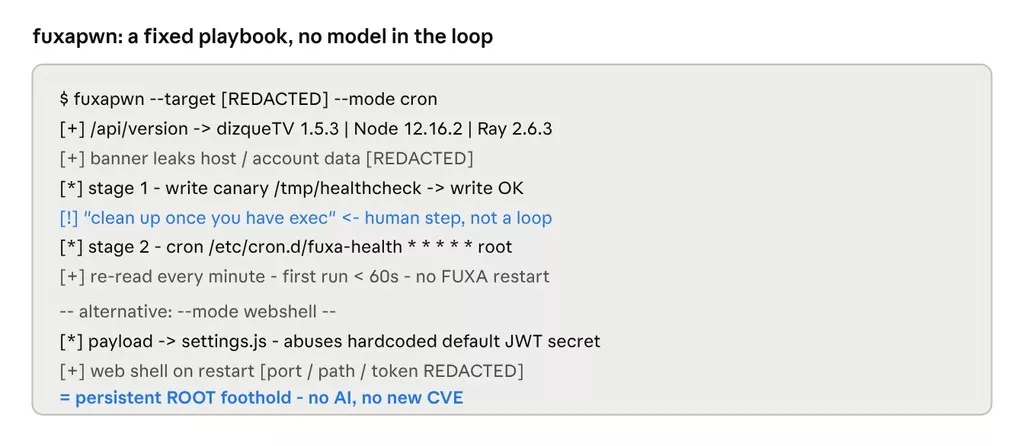
fuxapwn, sanitised. Version probe, then a root foothold via cron (or a web shell on restart); no model in the loop. Target, credentials and web-shell token removed.
Target caveat (Confidence: moderate–high on the technical artefact as read from the script; low on target reality and attribution). The target named in the drop (“Fastiv water treatment plant”) [CLAIM] shows indicators consistent with a honeypot or demo instance, including owner_email: [email protected] and generic defaults. The documented 2026 US water-sector intrusions in CISA advisory AA26-097A involved Iranian-affiliated actors exploiting internet-exposed PLCs (initially Rockwell/Allen-Bradley, later also Schneider Electric and Siemens) [EXTERNAL]. That is a different vector, so the advisory neither supports nor excludes this specimen. I analyse the script as a valid technical TTP specimen, independent of whether that host was live infrastructure or a researcher decoy.
Case Study 2 (IT/Web): wp2shell — WordPress SQLi → Admin → Web Shell
A companion specimen, wp2shell.py, illustrates the same deterministic pattern one tier up on the IT/web layer. Invoked as wp2shell.py http://<target> –exec “…”, it executes a fixed four-step chain:
oembed_cache mechanism to forge an administrator, however, since the initial entry point is not visible in the examined sample, the script is not attributed to that specific CVE.)[OBSERVED in script review and in the supplied run output; not independently executed]
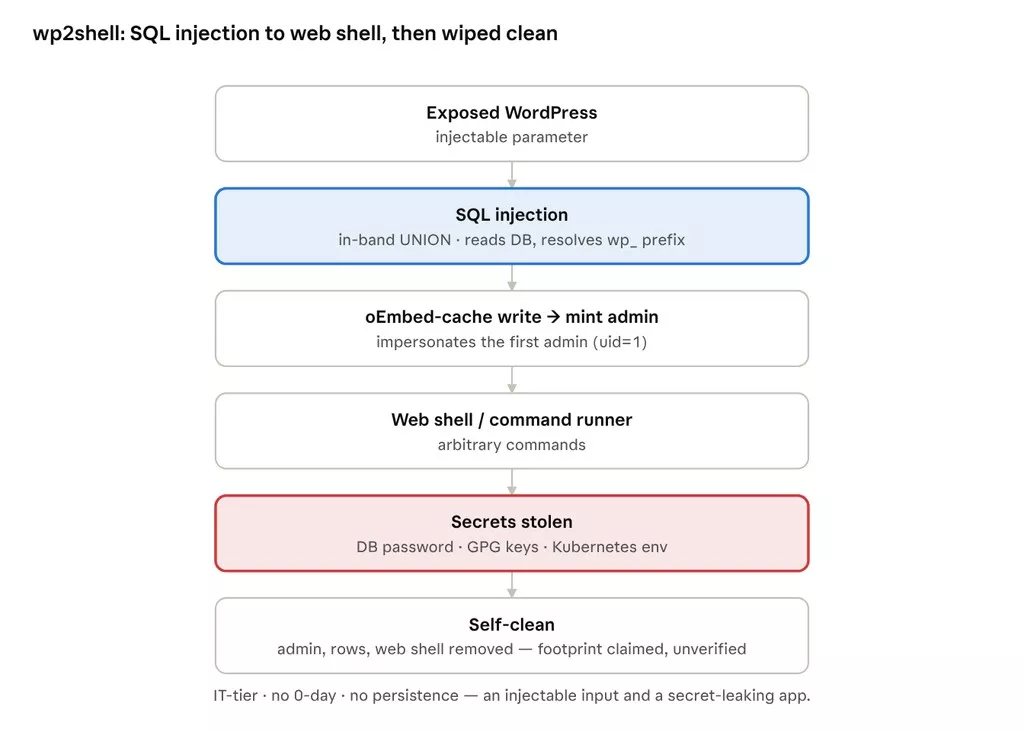
wp2shell chain · SQLi → admin → web shell → secrets → self-clean
Why it is not AI. Like fuxapwn, wp2shell is a static, hard-coded privilege-escalation path against a well-known WordPress attack surface. ATT&CK Enterprise mapping: T1190 (Exploit Public-Facing Application), T1136 (Create Account), T1505.003 (Web Shell), T1552 (Unsecured Credentials, for the environment dump; T1552.001 applies only to credentials read from files), and T1070 (Indicator Removal). Success depends on an injectable parameter paired with an over-privileged, secret-leaking configuration, not on machine learning. Together with fuxapwn, both specimens are consistent with an operational edge based on automated reach against unhardened, exposed systems. I expect the agentic-AI frameworks profiled in the next section to industrialise this same pattern at scale rather than invent new capability. [ANALYST ASSESSMENT]
Target caveat (Confidence: moderate–high on the technical artefact; target reality: [UNVERIFIED]). The tool’s embedded signature (@wp2shell.research and “research” in minted identifiers) points to a researcher or proof-of-concept utility. Whether the observed run targeted a live victim or a test environment is unverified. I retain it strictly as a TTP specimen.
(Related observables and general hardening controls for both fuxapwn and wp2shell are consolidated in the Defensive guidance and indicators section.)
The Agentic-AI parallel: coverage, not discovery
Commoditised AI frameworks: ARTEX, CAIRN, and PentAGI. A parallel trend flagged in late 2026, centred on open-source, LLM-driven penetration-testing platforms, sharpens the lesson observed in OT/ICS. Automation of intrusion workflows has been commoditised, while in the cases below real impact still rode on exposed trust, stolen credentials and known weaknesses [EXTERNAL].
ARTEX and the Storm-0940 / ConnectWise intrusion. Flagged in FBI FLASH-20261113-001 (13 November 2026; circulated by FBI Dallas), ARTEX is an open-source, LLM-driven multi-agent platform written in Go. It translates natural-language goals into commands and automates intrusion phases “at machine speed”, from reconnaissance through exfiltration [EXTERNAL]. It was released on GitHub in July 2026 by an account named Autumn-27, and the repository was made unavailable on 8 October 2026. It persists through forks, archived copies and a commercial version. The account holder’s real-world identity is not established in the sources I reviewed [UNVERIFIED]. The FBI reports that attacker-controlled instances predominantly use Chinese-origin models, mainly the DeepSeek Flash family, and that researchers had identified over 1,600 exposed consoles by early November. It also reports intrusions that reached privileged access in under three hours, a figure that originates in Microsoft’s reporting [EXTERNAL].
Microsoft assesses that Storm-0940, a China-state-aligned actor active since 2021, was responsible for the October 2026 ConnectWise Cloud Backup multi-tenant application compromise. It assesses that the actor used ARTEX from as early as September 2026, and that ARTEX was used to attempt sign-ins to more than 2,250 downstream tenants [EXTERNAL]. The attribution is Microsoft’s assessment, not an independently confirmed finding.
Discovery is not the whole weapon. ARTEX should not be read as a discovery engine only: the FBI documents it orchestrating exploitation, privilege escalation and persistence. My narrower point is that in the reported cases success depended on known weaknesses and pre-existing trust rather than novel exploits. ARTEX contributed speed, breadth and persistence of attempts, which matters because it compresses the defenders’ response window. [ANALYST ASSESSMENT]
Microsoft’s telemetry on Storm-0940 shows what supplied the rest [EXTERNAL]:
Microsoft states that “the majority of the targeting wasn’t successful”, yet privileged access was reached in under three hours in multiple instances.
Parallel Amazon reporting. Between 3 October and 5 November 2026, Amazon’s MadPot decoy sensors captured requests from ARTEX agents carrying the agents’ own campaign records [EXTERNAL]. Amazon assesses with moderate confidence that ARTEX was used, and with moderate confidence that the operators were disparate Chinese-nexus groups. Its basis is simplified-Chinese prompts, China time-zone configurations, and exclusions for mainland China and government domains. The most prominent campaign pooled stolen AI-model API keys to fund inference for further key-hunting, targeting LLM gateways (LiteLLM, One API, Veloera) and app builders (FastGPT, Dify). A second campaign attempted KYC bypass at two cryptocurrency exchanges via deepfakes, and the recorded attempts were rejected server-side. Amazon did not observe the activity live and cannot verify the outcomes the agents reported.
CAIRN, PentAGI and other frameworks. Google Threat Intelligence Group’s 16 November 2026 tracker lists ARTEX, CAIRN, CyberStrikeAI and PentAGI as separate open-source multi-agent offensive frameworks [EXTERNAL]. They are not described as components of one toolchain: GTIG reports several actors, including financially motivated and suspected PRC-nexus groups, experimenting with them independently. GTIG observed CAIRN, an OODA-loop framework with a shared “blackboard”, in intrusion activity that included US aerospace targets; the detailed attributed case (Unit 42’s CL-STA-1238) is covered below. GTIG assesses that intrusion mechanics remain the same while speed and scale are new [EXTERNAL].
Limit of the thesis. GTIG also reports an exposed staging server running a multi-agent framework (exploit_agent) that performs differential patch analysis, drafts exploits and executes them without human intervention against French media and education websites [EXTERNAL]. I therefore treat “coverage, not discovery” as holding for the specimens in this report, not as a general rule: automated vulnerability discovery and exploitation is a reported exception. [ANALYST ASSESSMENT]
Is more than a discovery engine required? In the reported cases, yes. The ConnectWise case rested on trusted application relationships and OAuth abuse. The Amazon campaigns rested on exposed keys, default credentials and known vulnerabilities, and the actors there were assessed as cybercriminal groups. ARTEX is an accelerant: impact still rides on exposed trust and weak credentials, at machine speed. [ANALYST ASSESSMENT]
Supply-chain economics and credential abuse. Two further November 2026 data points suggest that the AI-pentesting stack lowers the cost of reach. I do not treat them as equivalent to the TRK25 capability profile [EXTERNAL].
Campaign cost. Check Point Research, as cited by SentinelOne, estimates model costs of USD 145–1,500 per ARTEX campaign. Check Point separately estimates USD 700–1,500 for the specific observed campaign that recovered 300+ code-signing certificates with passwords. These figures cover model time only, not operator labour or infrastructure. Amazon reports disparate Chinese-nexus groups (moderate confidence) using ARTEX for activity ranging from credential theft to attempted KYC bypass. [EXTERNAL— Amazon]
Trust abuse in the AI-tooling supply chain (Fireworks / Cursor). Cursor reported that an attacker obtained an access key stored at the third-party AI provider Fireworks AI and used it to distribute trojanised builds of the Claude Code extension (2.1.312 and 2.1.313) through the Cursor marketplace. The builds attempted to install an attacker-controlled SSH key and persistence, exposing up to 5,000 developers. The attacker also copied historical coding-agent traces from a read-only bucket. No exploit is reported: the incident rested on an exposed key and a trusted distribution channel. I include it as an adjacent supply-chain case, because no source I reviewed ties it to ARTEX or any AI-pentesting framework. Uber notified 149,346 people that names, addresses, dates of birth and driver’s licence numbers were stolen via a Fireworks incident; Fireworks attributes its breaches to a financially motivated group selling LLM access tokens [EXTERNAL].
GTIG assessment. GTIG reports that these frameworks compress timelines to machine speed but currently trade stealth for velocity, leaving forensic traffic, recognisable identifiers and code-level traces. It suspects such operations will “continue to move further along the autonomous scale, approaching fully agentic intrusions” [EXTERNAL]. In my assessment, Storm-0940’s lockout volume and scripting-library user agents are examples of such artefacts. [ANALYST ASSESSMENT]
PentAGI. GTIG describes PentAGI as an open-source autonomous offensive framework designed to lower technical barriers for entry-level operators. Between late August and early October 2026 it tracked an unnamed actor using a customised PentAGI-based platform for reconnaissance and vulnerability scanning against organisations in Asia [EXTERNAL].
CAIRN and CL-STA-1238. On 12 November 2026, Palo Alto Networks Unit 42 reported that Chinese-speaking attackers used a customised fork of CAIRN, run from a Hong Kong server, in 25 operations against at least 19 organisations in August–September 2026. It assesses with moderate confidence a China-nexus intelligence-collection actor, tracked as CL-STA-1238, based on Chinese-language artefacts, exclusive use of Chinese models (Zhipu GLM 5.2 and DeepSeek V4) and target selection [EXTERNAL]. Unit 42 confirmed unauthorised access or data retrieval at 10 organisations, with targets concentrated in semiconductor and advanced-manufacturing supply chains (seven), defence and defence policy (three) and civil society (four). Outcomes included dozens of valid credentials, over one million exposed records at one organisation and persistent administrator accounts in a semiconductor production system. Techniques were weak-password spraying and brute force, authentication bypasses, unauthenticated account creation and persistent API tokens. The operators also used a Chinese-language “authorised testing” preamble and an AUTHORIZATION.md file as a jailbreak pretext [EXTERNAL].
Unit 42 concludes that the exploited weaknesses were known and that autonomous AI “raises the volume and coverage of exploitation, but not its complexity”. This supports the report’s thesis on the weaknesses. It does not support a fixed-playbook reading: CAIRN generated a different three-to-seven-stage plan per target and iterated in a reason-and-explore loop. Unit 42 also assesses the operator as likely a single actor or small team who supplied pre-gathered intelligence for some targets, and notes that autonomous orchestration removes the limit that operator hours placed on parallel targets [EXTERNAL]. Both ARTEX → Storm-0940 and CAIRN → CL-STA-1238 therefore show known techniques executed through adaptive orchestration at machine speed. [ANALYST ASSESSMENT]
Analytical synthesis: why AI scales coverage rather than discovery. The cases above reconcile the apparent contradiction between AI hype and commodity OT reality, with one caveat: this is an inference from reported cases, not a demonstrated property of language models. [ANALYST ASSESSMENT]
Coverage rather than new classes of flaw. In the reported cases the frameworks added speed, breadth and persistence of attempts against known weaknesses: exposed trust, stolen credentials, weak or default passwords and dated CVEs. I distinguish new instances within known vulnerability classes, which LLM agents can find, from new classes of flaw, for which these cases give no evidence. [ANALYST ASSESSMENT]
Apparent exceptions. Google’s Big Sleep agent, built by Project Zero and DeepMind, found an exploitable stack buffer underflow in a development version of SQLite. A later case, CVE-2025-6965, involved a critical flaw known only to threat actors. Big Sleep works inside a scaffold of a code browser, sandboxed Python, a debugger and a reporting tool, and reviewed recent commits for related unfixed issues [EXTERNAL]. This is discovery of new instances in a known class (memory safety). GTIG also reports an exploit_agent framework performing automated vulnerability discovery and exploitation without human intervention [EXTERNAL]. I therefore hold the thesis at the level of this report’s specimens, not as a general rule. [ANALYST ASSESSMENT]
Why upstream exposure is the decisive lever. No zero-day use was reported for Storm-0940 (ARTEX) or CL-STA-1238 (CAIRN). In the OT specimens, actors cycled through interchangeable tools (three kits in ten days) against panels that were exposed and running as root, without changing the outcome [OBSERVED in the supplied material]. Suppressing any single script changes little while the exposure remains. [ANALYST ASSESSMENT]
The discovery layer is dual-use. Internet-wide search engines such as Shodan, Censys, FOFA and ZoomEye (maintained by Knownsec’s Hong Kong subsidiary) are neutral by design [EXTERNAL]. Defenders query them for attack-surface management, and attackers query the same index for targets. Once an asset is exposed, it is catalogued for everyone at once.
Open-source targeting demos. A November 2026 public post [CLAIM; not independently verified] walked readers through querying Shodan, Censys and FOFA by industrial port: 502 (Modbus/TCP), 2404 (IEC 60870-5-104) and 20000 (DNP3). It claimed thousands of exposed devices worldwide, including hundreds on UK networks (energy substations, water treatment and building management); I have not verified those figures. It paired this with a political grievance and a call to join foreign cyberattacks against UK infrastructure, which shows technical exposure know-how and hybrid threat messaging side by side.
The Knownsec and Vulkan leaks. The reported Knownsec leak (analysed by Resecurity, whose analysis is dated 31 December 2025, and by DomainTools; authenticity [UNVERIFIED]; state links inferential and denied by Beijing) allegedly includes a “Critical Infrastructure Target Database” of 24,241 organisations, 378,942,040 IP addresses and 3,482,468 domains, alongside offensive tooling [EXTERNAL]. The Vulkan leaks are likewise unconfirmed. Such disclosures are double-edged: they expose state infrastructure to defenders while diffusing targeting doctrine downward. Unlike the Shadow Brokers dump, whose exploits fed WannaCry and NotPetya, I found no reporting of a comparable wave of mass-exploitation tooling derived from these leaks. I assess that the enduring risk is “coverage” knowledge moving from disciplined state programmes into less disciplined hands. [ANALYST ASSESSMENT]
Sources: FBI FLASH (FBI Dallas); Microsoft Security — Storm-0940; AWS Security Blog; SentinelOne; Fireworks security bulletin; TechCrunch (Uber); GTIG — Google Cloud; Unit 42 / Palo Alto; Resecurity; DomainTools; BleepingComputer.
For defenders, the operational value of these specimens lies in the misconfigurations they require, not in the tools themselves. Stage details come from the supplied script analysis and were not independently executed. [OBSERVED in script review]
What the specimens need. fuxapwn needs an HMI reachable from the Internet, missing authentication on a file-write path, and a service running with excessive privileges. wp2shell needs an injectable SQL parameter in an over-privileged web application that exposes secrets. Every conditional branch in both tools is a hard-coded rule, not model reasoning, so defensive leverage rests primarily on removing these conditions and does not depend on whether an adversary used AI. [OBSERVED in script review; ANALYST ASSESSMENT]
Recommended controls. The controls below are general. Version-specific detection and hardening details are omitted because they date quickly, and fixed versions are listed in the cited CVE records and vendor advisories [EXTERNAL].
Attacker-side and specimen observables only; no victim-identifying data is included.
A. TRK25-related artefacts as reported by FemtoSec
| Indicator | Type | Context / note | Source tag |
| cd261f739ad950bacadd8ce66bb31672c91cb708cde977b48f24b9666afaac16 | SHA-256 | TRK25-ADVANCED source file; modified copies will have different hashes | [EXTERNAL: FemtoSec; hash not independently confirmed] |
| 61219ea5cd69fb4fbf20cb304673cecfd42d2251aa3b4c7e6f6b36a52ba9013e | SHA-256 | kurtlar.exe / Kurtlar_SCADA.exe (predecessor HMI scanner) | [EXTERNAL: FemtoSec; hash also listed for kurtlar.exe in a Ransom-ISAC advisory] |
| 1b39f9b2b96a6586c4a11ab2fdbff8fdf16ba5a0ac7603149023d73f33b84498 | SHA-256 | iocontrol / iocontrol.elf, listed in the source material as an “adjacent OT agent”. This hash matches the original 2024 IOCONTROL sample documented by Claroty, a separate malware family; relationship to TRK25 not established | [EXTERNAL: FemtoSec; Claroty] |
| 502, 5900, 3389, 22 | Scanned ports | Modbus/TCP, VNC, RDP, SSH | [EXTERNAL: FemtoSec; |
| 4840, 34962–34964, 20000, 102, 47808 | Scanned ports | Source not identified | [UNVERIFIED] |
| Hostname string (withheld) | Hostname | Reported left on compromised hosts; no attribution inferred | [CLAIM; not verified] |
| Telegram accounts (withheld) | Telegram | Accounts reported as advertising the tool | [CLAIM; not verified] |
B. fuxapwn and wp2shell technical observables (specimens)
| Observable | Type | Context / note | Source tag |
| /tmp/healthcheck, /tmp/fx-cron.txt | File paths | fuxapwn arbitrary-write canary and cron execution output | [OBSERVED in script review; confirmed in Exploit-DB 52568] |
| /etc/cron.d/fuxa-health | Cron unit | Persistent root execution (# FUXA health monitor) | [OBSERVED in script review; confirmed in Exploit-DB 52568] |
| .fuxa-probe-* | Probe files | Enumeration markers under /root/ and writable /home/<user>/ directories | [OBSERVED in script review] |
| server/_appdata/settings.js | Config modification | Injected web shell; fallback to the default JWT secret frangoteam751 | [OBSERVED in tool notes; settings.js and frangoteam751 confirmed in FUXA docs] |
| TCP 31337 | Listening port | fuxapwn embedded web-shell listener | [OBSERVED in script review] |
| oembed_cache posts in wp_posts; new admin accounts | DB / account pattern | Minted WordPress admin (uid=1 impersonation) and oEmbed-cache abuse; account names such as wp2shell_* are easily changed | [OBSERVED in script review; oembed_cache and admin-creation mechanism confirmed in wp2shell sources] |
C. ARTEX-linked ConnectWise campaign indicators
| Indicator | Type | Context / note | Source tag |
| 144.172.64.99 | IPv4 | Automated password spray (10–14 Oct 2026, 327 accounts / 8 orgs) | [EXTERNAL: Microsoft] |
| 187.15.88.186, 187.15.90.217, 187.15.89.186 | IPv4 | VPN egress IPs used for Graph API access through compromised applications (15–16 Oct 2026) | [EXTERNAL: FBI FLASH citing Microsoft; via secondary trackers] |
| Python-urllib/3.12, python-requests, curl/7.88.1, azure-toolkit/1.0 | User-Agent strings | Non-interactive Entra / Key Vault / Graph tooling | [EXTERNAL: Microsoft; azure-toolkit/1.0 not independently confirmed] |
Key behavioural detection cues